

A bit of history first. New Year’s Day didn’t always fall on 1st January. Over 5,000 years ago, Jews celebrated the new year during the ten-day ceremonies of Rosh Hashana and Yom Kippur. The Day of Atonement – Yom Kippur – being the most solemn event in the Jewish calendar. It occurs in September and/or October depending on the lunar year, where each adherent recognises their imperfections and sins and asks God to inscribe them into the Book of Life for the coming year. The Jewish New Year always began shortly before the harvest.
About 4,000 years ago the ancient Babylonians celebrated their new year in mid-March at the start of the planting season in their twelve-day religious festival called Akitu. Promises were made to their gods to pay debts, often vowing to return borrowed objects whose whereabouts were long forgotten. It was essential to start the new year speaking to the right gods and making amends for any sin.

When Julius Caesar reformed the calendar in 46 BCE, he established 1st January as the beginning of the new year. The two-faced god Janus oversaw it ringing in: with one face looking backward to the old year, and the other face looking forward to the new one. There was no particular element of breast-beating for bad behaviour of the past, but Romans carefully promised good conduct to Janus for the future, offering sacrifices.
It wasn’t until the medieval Christian period that new year’s resolutions and gifts took on a religious meaning. Knights often took the ‘peacock vow’ after the twelfth night in an elaborate festival to recommitment to chivalric code of the day. Over time, Christians used the start of the year for reflection and resolving to improve their behaviour.
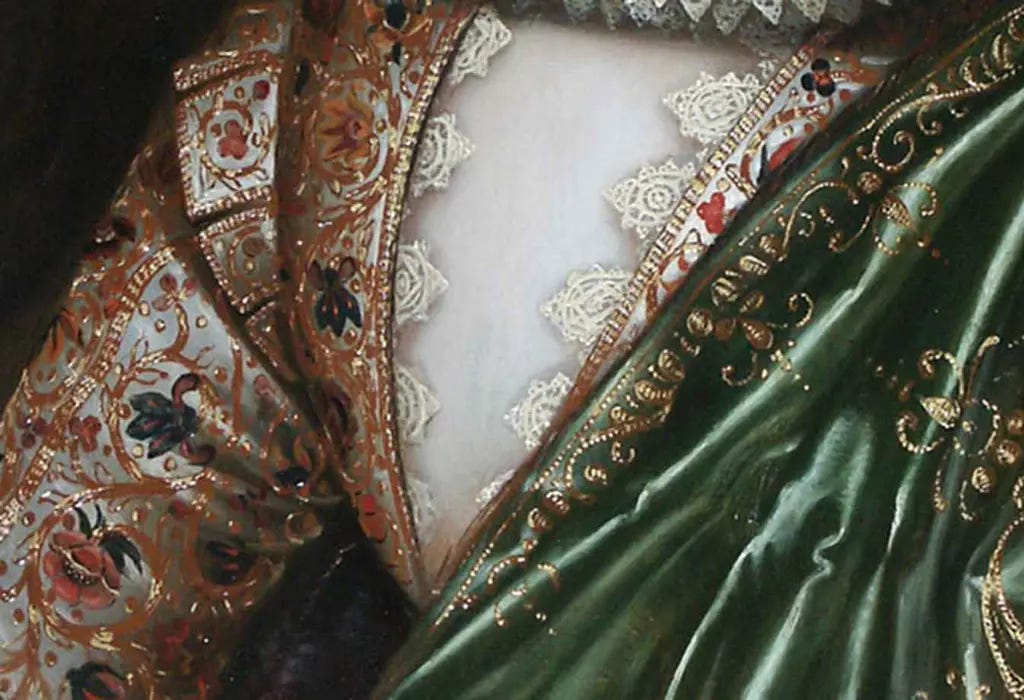
For Queen Elizabeth I, it was all about her New Year’s booty on ‘Lady’s Day’ the 25th March (a remnant of which lives on in our 6th April financial new year). Throughout her long reign, courtiers vied for top dog, often gauged by the gift’s unusualness and cost. Gold, silks, jewels were often on the list. Fine chambray embroidered with gold or silver gilt from Bess of Hardwick is an example as seen below. Elizabeth’s gift rolls still exist at the National Archives and would be enough to replenish the UK’s faltering economy today. But all changed in 1569 – the New Year’s that Mary Queen of Scots lost at the Battle of Langside, and she thought she could take refuge in England, perhaps hoping to take the English throne as well. Politics entered the gift-giving scene that year, for every courtier and foreign ambassador worth his salt had to prove loyalty to Elizabeth with ever more exotic and magnificent tokens.
It wasn’t until the 17th century that New Year’s resolutions and a focus on self-improvement became more commonplace. By the Victorian era, it was part of the nation’s psyche.
Today, the top resolution is to spend more time with friends and family. We are still creatures of habit and changing habits – particularly when children are all grown up – takes both sides to make the wish come true. This resolution is followed closely by losing weight, doing more sport, drinking less/eating more healthily. Some of us succeed. Others don’t despite the best intentions. . . and we all know which road those tend to pave.
Failing in a New Year’s resolution doesn’t come with a skull and crossbones warning. Most are diligently made, and difficult to keep. So, I decided to make a resolution that I could easily make stick. But I cheated. I needed a resolution to start the year as I meant to go along. I made the same resolution back in 2017 when I submitted my proposal for my book Condé Nast: The Man and His Empire, published in 2019.
Before I tell you, please allow me a segue. All of my books have an underlying thread of power and greed laced through its pages. Someone once asked me why. It was just after I’d written A Dangerous Woman about Florence Gould. I replied, ‘I understand power and greed. I am a former advisor to governments and high net worth individuals and I’m an historian.’ An honest answer to an honest question without giving away any state secrets.
What I didn’t say was that Florence Gould got to me. I hated her. When you write a biography you have to live with that person for two or more years from idea to publication. All my other books had components that were difficult to write, showing an inhumanity that I was able to rise above to show in a true and dispassionate light. Florence was different. During writing, I often shut down my computer and go for a walk with the dogs. Or feed the sheep. Or make a cuppa. Or an elaborate dinner. Anything to get back to being honest, dispassionate, informative and compelling for the reader. So come New Year’s 2017, I set my resolution to write about the ‘good guys’ for a change.
Six months of research ensued. I wanted to find a person who had both power and was greedy for money – but who was a ‘good guy’ or ‘good gal’. No matter where I looked, aside from Queen Elizabeth I, I failed. (My then agent said I mustn’t return to my Tudor roots.) Then one day in July, coming back from London, my train was delayed, so I popped into the WH Smiths. Staring at the magazines, it hit me. Maybe Hearst? Maybe Condé Nast? Within the hour, Hearst was eliminated – having singlehandedly started the Spanish American War to take over Cuba through his ‘yellow journalism’ back in 1898.
With each research document, I discovered Condé Nast was my ‘good guy’. Upright. Hard working. Sporty. Funny. Fun. Dedicated to his mother and sisters. Wise. He came from wealth on his mother’s side. His father’s side were committed German Methodists. That said, his father was a ne’er-do-well who abandoned the family until Condé was seventeen. Condé made his first fortune by buying a sewing pattern company on the cheap and making the first ‘different sized’ sewing patterns for women, back when women made their own dresses or had a dressmaker. Until Condé Nast, unless you were a size twelve, you had to change your pattern yourself and hope it would fit. A real contribution to the women of his day. By the time he’d bought Vogue he’d also developed an eye for talent. He was the first to employ Dorothy Parker. The near seven-foot-tall Robert Sherwood, winner of three Pulitzer prizes, with a morbid fear of little people would go on to become Roosevelt’s speechwriter, and in charge of US ‘information’ (read censorship) in the Second World War. Cecil Beaton and Noel Coward got their first ‘pay checks’ in the USA from Condé Nast. Clare Boothe Luce, writer, playwright, and Congresswoman was managing editor of Vanity Fair. It didn’t matter if you were Black, Gay, Jewish or Irish (the main bugbears of his day). Only that you were the best at what you did.
Given the whirlwind of anger today, I reckon 2026 needs ‘feel good’ stories. A romance – no, a towering love – set against impossible times, replete with unexpected twists, gallows humour, and recognisable baddies whose power is misused and monumental. Yet the heroes in my world carry on regardless. Because of love.
After so many injustices and insults against ordinary people struggling to get by, most often inflicted by their own leaders, I’d like to see the literature of 2026 and beyond show us the honesty, respect and understanding we deserve. And of course, that towering love set against impossible times.
It’s tall order order, I know. But it’s my New Year’s resolution to build that world on the printed page. I can only hope the gods of publishing – whoever they may be – will agree that it will be worth their time, paper and ink. It’s my way of contributing to the ‘greater good’. It may never be more than a needle in a Substack, but I do hope to share it with you soon.
I wish you all a very Happy New Year.