

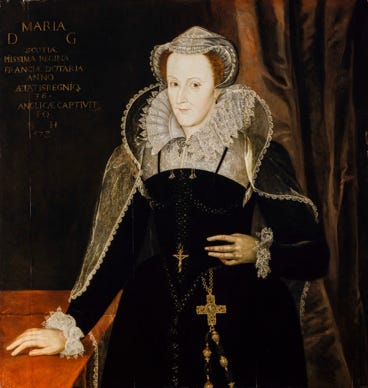
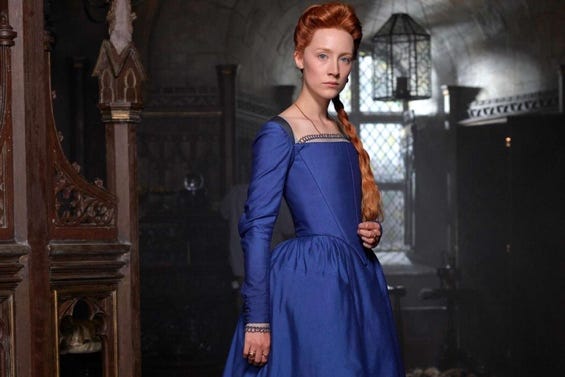
Several years ago, I optioned Antonia Fraser’s Mary Queen of Scots to bring the book to the big screen. It was the first biography I read when I was young. The central conflicts in the book also compelled me to study the first Elizabethan Age, hoping to write about it someday. It was more than a pipedream. By 2012, I’d published two quite original takes on Elizabeth I’s reign, The Pirate Queen (2007) and Heretic Queen (2012) – both nods to Philip II of Spain who had scrawled these unflattering monikers for Liz with a shaky hand in his personal archive. I was thrilled when Antonia gave me a blurb for Heretic Queen.
You may wonder why Antonia would let a complete unknown in screenwriting option her seminal work. (It certainly wasn’t for the money.) The best explanation is that she knew I was part of the team who discovered the screenplay by an unknown screenwriter called David Seidler (the seventy-four-year-old late blooming Oscar screenplay winner of The King’s Speech). My friend who represented Seidler and I had taken Antonia to an early showing of The King’s Speech. Antonia insisted on seeing “our credits”, whispering to me that she was so moved by the film she was just wanted to stay and absorb the atmosphere in the cinema. She remained in her seat to see our credit beneath the Corgis – yes, we were the ‘underdogs’ and the last to roll. And yes, there’s a whole sorry saga behind that.
Unfazed by my brush with putting together a film as an executive producer (our team had raised seed capital and attached Geoffrey Rush and director Tom Hooper), I wrote a screenplay of Mary Queen of Scots based on Antonia’s book. She loved it. Naturally my husband and I took Antonia and her agent out to supper to celebrate. During dinner she made a remark that I’ll never forget: “Harold (Pinter, her husband) used to say that theatre and cinema was all about emotion. It’s meant to be entertainment embodied in the performances, direction, setting. Your screenplay made how I believed Mary and Elizabeth may have acted come alive.” Thank you, Antonia. The other point she made was when an historian adapts a real person to the stage or screen, history takes a back seat – but still needs to travel in the automobile. Meaning there’s a certain duty to truthfulness.
Just as I was ready to market my Mary screenplay, the news broke: Tim Bevan and Eric Fellner of Working Title were producing Professor John Guy’s Mary Queen of Scots: The True Life of Mary Stuart written by Beau Willimon (House of Cards). Timing is everything, and mine was awful. Apologies were made, and Antonia was most gracious and understanding. The option lapsed and screenplay resides in my archive untouched since then. Don’t worry though, it’s not lonely. There are a handful of friends sitting in the archive warming its cockles.
I know from both fantastic and bitter experiences that timing is behind all successes and failures. For example, I couldn’t understand why one of my all-time favourite actors hadn’t made more of a splash. Her name is Jessie Buckley. I fell in love with her incredible talent when I saw her in Wilkie Collins’s The Woman in White in 2018. The following year she portrayed Lyudmilla Ignatenko in Chernobyl followed by Rosalyn Wilder in Judy. I was completely blown away. She is so multitalented, so believable, so owns the space of whoever she plays. And she sings, too! Nobody, in my opinion, deserves greater accolades. I do hope she wins her Oscar and only wish the film well.
That said, there is what I call the “Shakespeare Dichotomy” – a disconnect between academia and performance. For Shakespeare scholars writing about Shakespeare as a person and what he thought and did, seemingly can’t advance our understanding of his poetry and plays. Conversely, actors, directors, producers love reliable information and history about him, his times and the theatre to be better able to ‘own the space’ authentically. Despite my wishing the film well – and certainly hoping to see Jessie Buckley lift her well-deserved Oscar – I have my foot firmly in the same camp as Shakespeare expert Jonathan Bate voiced in his The Times article of 17th January. It is a beautiful film, expertly directed and gorgeously acted, but it is not either Anne or Will Shakespeare’s story. It’s entirely Maggie O’Farrell’s invention, her ‘idle speculation’ as she calls it in her author’s note. It is a fiction that many who see read the book or see the film will think “this is how it was” with Will and Anne when nothing could be farther from the truth.
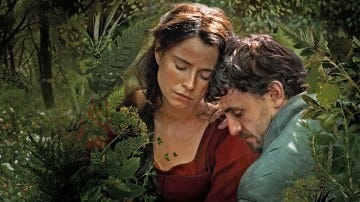
While I loved the film as entertainment, I struggled with the book. The history and biography of this more than famous family was all wrong. Like Jonathan Bate, I know Hamnet did not die of plague. I sped read Hamnet to the end. When I saw Maggie O’Farrell’s author’s statement, I was not surprised.
And this is precisely what Antonia Fraser meant. The visual experience of plays and movies is about the emotion conveyed. Individual actors can make or break any performance just as a director or set designers, costumiers or others involved in the feel of the production can do. Reading a book – even a novel – when you know something about a real person is false – shockingly false – from plague years to how the theatre worked to Anne’s real activities to Will and his friends in the theatre – it grates. It made me, and several other people from the Shakespeare world I know put the book down in disgust.
This “Shakespeare Dichotomy” between acting and academic study is real, making relations at best tenuous. At times it’s quite frayed or non-existent. Not every scholar is as versatile as Jonathan Bate and able to write a smashing one-man play for another favourite of mine, the delightful Simon Callow. When was the Chief Executive of a Shakespeare charity which purported to want to bridge the gap between performance and Shakespeare’s plays, I experienced the difficulties within the Shakespeare industry first-hand.
I produced the first-ever promenade performance of Hamlet at Elsinore Castle in Denmark and sat next to one of the great expert Shakespeareans of the day, Stanley Welles, at the gala dinner. We chatted about the performance, the castle, and the play. I asked him what his thoughts were about Will’s father, John, being a Catholic. A dismissive wave of the hand. The chit chat continued for a little while before I dared to ask if he had ever thought about all the Lord Chamberlain’s Men who are documented as having performed at Elsinore Castle. He raised an eyebrow and began eating his dessert. Undaunted, I asked if he’d like to see where Bothwell, Mary Stuart’s last husband, had ended his days in the castle’s dungeon. Stanley slid an eye towards me as if I was giving him indigestion. I rabbited on about how Elizabeth I used players as “reliable intelligencers” and told him about my visit to the Dutch and Danish archives. Was that a sneer or a smile Stanley gave me? Let’s say it was a smile. Bravely or stupidly, I told him about my research and how the Lord Chamberlain’s Men had travelled to “the Low Countries” most likely at the behest of the queen or the Earl of Leicester. After all, Elizabeth I was helping to fund what became known as the Eighty Years’ War in the Netherlands and needed intelligence she could trust. Stanley said nothing, but I could feel his hackles rise. He politely turned to me and quoted the great Bard, “The play’s the thing, Susan.”
For me, “Academia” had spoken. Still, I agree and disagree with Stanley. With fiction passing increasingly as fact these days, as biographers and historians I do think we have a duty to portray real people within the context of their times accurately on the printed page. Even in novels.
Much water has passed under the proverbial bridge between actors, directors, and academia since then. My Shakespeare non-fiction book languishes in my bulging archive. Since then, I’ve rewritten my Shakespeare novel and screenplay, but as with Mary Queen of Scots, my timing stinks.
C’est la vie.