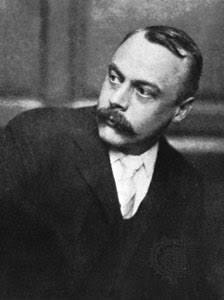
It may be considered unusual for a Scotsman to have written a bestselling, long-selling eulogy to the river Thames, but not if you’re a Scotsman who lived most of your childhood in Oxford and Cookham Dean in Berkshire. Born in Edinburgh on 16 March 1859, Kenneth Grahame was the third child of James Cunningham Grahame and Elizabeth Ingles. His mother died a few weeks after the birth of his younger brother Roland, who barely survived. Kenneth was aged five at the time, and his father seemingly was unable to recover from the loss of his wife. He ultimately decided to give the custody of his three sons and daughter to his own mother, and they were supported financially by their Uncle John. Their father would live the rest of his life in France. Not a very auspicious beginning for such a beloved children’s book author.
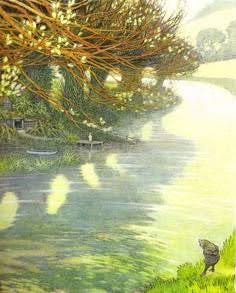
Yet, good was to come from the sorrow. From the tender age of five, Kenneth’s youth was spent along the river Thames. His grandmother’s house was called The Mount at Cookham Dean – a sixteenth century hunting lodge with twelve bedrooms set in 3.5 acres with stunning views overlooking the river Thames. This became his first home in England. The words written so much later as the author of The Wind in the Willows verbalise his childhood awe of the view from The Mount:
All this he saw, for one moment breathless and intense, vivid on the morning sky; and still, as he looked, he lived; and still, as he lived, he wondered.
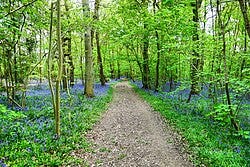
The Mount is situated next to Bisham Woods, a 349-acre protected woodland today, just to the south.
What could be more ideal for a small boy! When a chimney collapsed at The Mount, about a year before Kenneth was old enough to attend his senior school – the new St Edward’s School in Oxford – his grandmother decided to move the Grahame children and their Uncle John to Fernhill Cottage in Cranbourne. It was smaller, with only seven bedrooms and but quite close to Windsor Great Park. It was also farther from the Thames.
Although Kenneth experienced some difficulties in adapting to boarding school life and was bullied at the outset, he took refuge in the Thames – called the Isis in Oxford. He was already well-used to overcoming adversity, and his time spent larking near the river proved therapeutic. The sports fields at St Edwards border the river as it widens at Port Meadow, but Kenneth excelled at rugby, eventually becoming captain of the First XV. There is a line in Wind in the Willows that recalls those days:
‘By the side of the river he trotted as one trots, when very small, by the side of a man who holds one spellbound by exciting stories; and when tired at last, he sat on the bank, while the river still chattered on to him, a babbling procession of the best stories in the world, sent from the heart of the earth to be told at last to the insatiable sea.’
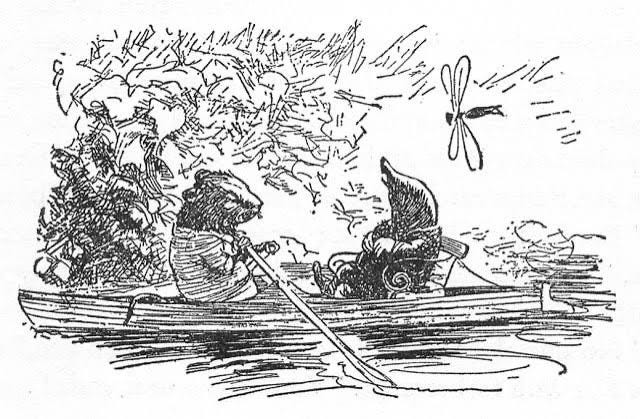
St Edward’s had (and has) a rowing team, but the Oxford Dictionary of National Biography does not mention that Kenneth was a rower. It does say, ‘The events of this period were reflected in the books on childhood which made his name, and the love that he developed for Oxford and the river remained with him.’ Clearly, Kenneth agreed with Mole that ‘There’s nothing – absolutely nothing – half so much worth doing as messing about in boats.’
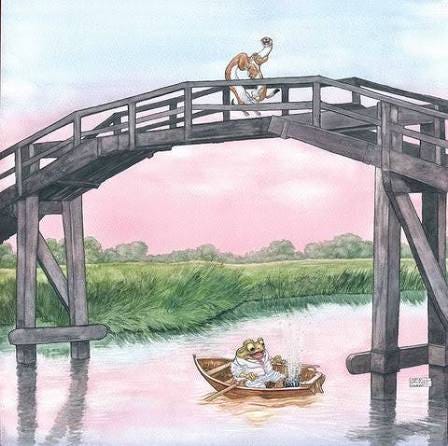
Kenneth Grahame became Head Boy at St Edward’s and was desperate to stay in Oxford, close to the river and attend university in the city if possible. Sadly, it was not to be. Uncle John exerted his financial muscle telling Kenneth that he thought university would be a waste of money – despite Kenneth winning the Divinity Prize, Latin Prize and Sixth Form Prize at school. This deeply wounded Kenneth but made him determined to become financially independent yet never relinquish his love of writing and literature.
By the age of eighteen, the river had become his refuge, his home, just like Mole:
He saw clearly how plain and simple – how narrow, even – it all was; but clearly, too, how much it all meant to him, and the special value of some such anchorage in one’s existence. He did not at all want to abandon the new life and its splendid spaces, to turn his back on the sun and air and all they offered him and creep home and stay there; the upper world was all too strong, it called him still, even down there, and he knew he must return to the larger stage. But it was good to think he had this to come back to, this place which was all his own, these things which were so glad to see him again and could always be counted upon for the same simple welcome.’
And so, against his will, Kenneth was off to London. At least the Thames was at its most majestic there and would still form part of his future as it meandered through the capital. Kenneth Grahame had grown into a tall (five foot eleven inches) attractive and kindly man. He hadn’t envisaged London as part of his childhood adventures even though he would later write the words, ‘Here today, up and off to somewhere else tomorrow! Travel, change, interest, excitement! The whole world before you, and a horizon that’s always changing!’ He loved travel, and the seaside of Cornwall too. Being near or on the water was often his safe place.
He would always have two sides to his life: that of the literary traveller, financially supported by his new life as a ‘gentleman clerk’ from 1 January 1879. On leaving St Edward’s, Kenneth took the Bank of England entry exam and is the only person to have scored 100% in the essay that was part of the qualifying test. He took a flat in fashionable, literary Bloomsbury which he shared with his younger brother Roland. Eventually, Kenneth would rise to become the Secretary for the Bank of England. He volunteered at Toynbee Hall working with the poor. And he continued to write. . . and write. It was only in 1887 that he had the confidence to submit his short stories and essays to magazines. In 1897, he married Elspeth Thompson and they had a son, Alistair.
A change in his writing fortunes came with a short piece entitled ‘The Olympians’ published in the National Observer on 19 September 1891. It was an ironic portrait of childhood, both refreshing and positive, and avoided the adult preciousness so prevalent at the time. It made him famous in the writing world overnight. More short stories followed regularly, and as his literary career took off, so too did his job at the Bank of England. He even wrote a story for the St Edward’s Chronicle. Soon enough, Kenneth’s short stories were grouped together by publisher John Lane in 1895 into a book entitled The Golden Age which A.C. Swinburne said was ‘well-nigh too praiseworthy for praise’.
But The Wind in the Willows published by Methuen in 1908 remains his most enduring work. It has had a lasting impact on children’s literature as a timeless tale of friendship and adventure, and a boy who could have been so easily lost to family tragedy found himself clearly reflected in the wildlife and his love of the river Thames.