

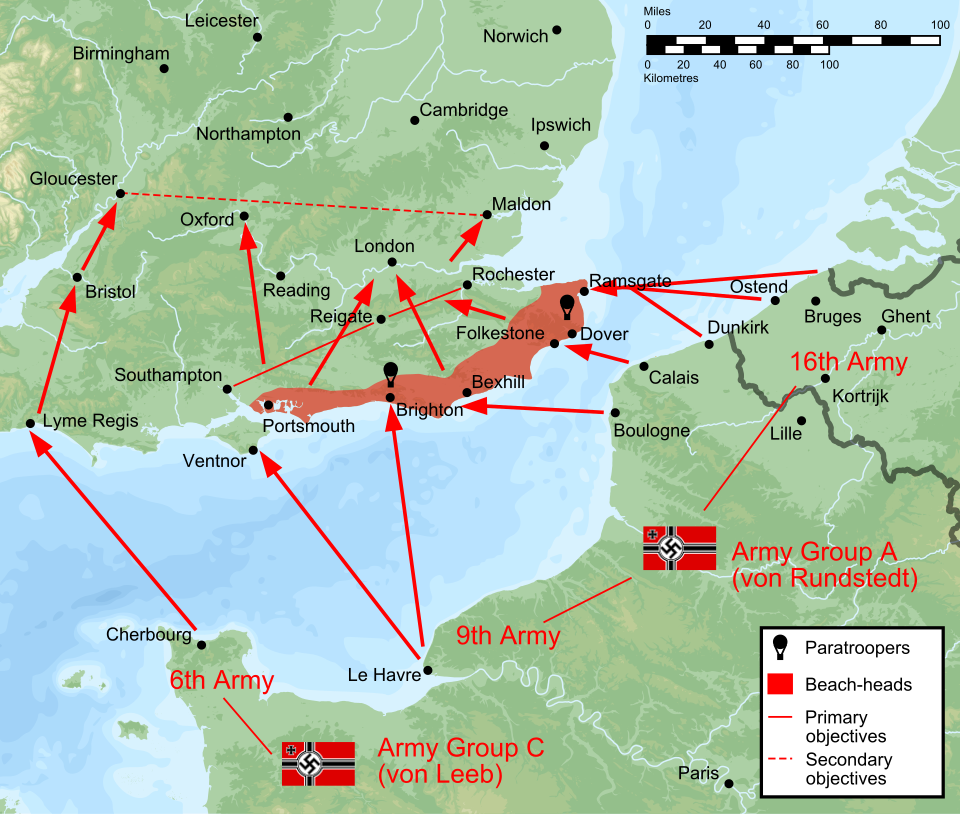
On 16 July 1940, Hitler issued seven copies of Directive 16 to the Supreme Commander of the Reich’s Armed Forces. Although looking like the map in the title sequence of Dad’s Army, Hitler’s intentions were deadly. His directive begins:
‘Since England, in spite of her hopeless military situation, shows no signs of being ready to come to an understanding, I have decided to prepare a landing operation against England and, if necessary, to carry it out.
The aim of this operation will be to eliminate the English homeland as a base for the prosecution of the war against Germany, and, if necessary, to occupy it completely.
I therefore order as follows:
1. The landing will be in the form of a surprise crossing on a wide front from about Ramsgate to the area west of the Isle of Wight. Units of the Air Force will act as artillery, and units of the Navy as engineers. The possible advantages of limited operations before the general crossing (e.g. the occupation of the Isle of Wight or of the county of Cornwall) are to be considered from the point of view of each branch of the Armed Forces and the results reported to me. I reserve the decision to myself. Preparations for the entire operation must be completed by the middle of August.
2. These preparations must also create such conditions as will make a landing in England possible, viz:
a. The English Air Force must be so reduced morally and physically that it is unable to deliver any significant attack against the German crossing.
b. Mine-free channels must be cleared.
c. The Straits of Dover must be closely sealed off with minefields on both flanks; also, the Western entrance to the Channel approximately on the line of Alderney-Portland.
d. Strong forces of coastal artillery must command and protect the forward coastal area.
e. It is desirable that the English Navy be tied down shortly before the crossing, both in the North Sea and in the Mediterranean (by the Italians).
3. For this purpose, we must attempt even now to damage English home-based naval forces by air and torpedo attack as far as possible.
4. Command organisation and preparations. Under my overriding command and according to my general instructions, the Commanders-in-Chief will command the branches of the Armed Forces for which they are responsible. From 1st August the operations staffs of Commander-in-Chief-Army, Commander-in-Chief Navy, and Commander in Chief Air Force are to be located at a distance of not more than 50 kilometres from my Headquarters (Ziegenberg). It seems to me useful that the inner operations staff of the Commander-in-Chief Army and Commander-in-Chief Navy should be placed together at Giessen. . . . The operation will bear the cover name “Seelöwe” (Sealion).
It rambles on for another 800 words in these general terms. History knows the outcome of the Third Reich’s Operation Sealion. The RAF’s survival owes as much to Hitler’s and Göring’s tactical errors as to its own aircraft, tactics, dedicated pilots and sheer bravado.
Still, the Luftwaffe blitzed London, Liverpool, Coventry, Exeter, Plymouth, Southampton, Bristol, Belfast, Cardiff, Hull, Manchester, Birmingham, Glasgow, and other strategic locations. Before the year was out, Hitler gave London a New Year’s greeting as Henry Mason’s iconic image of 30th December 1940 shows.
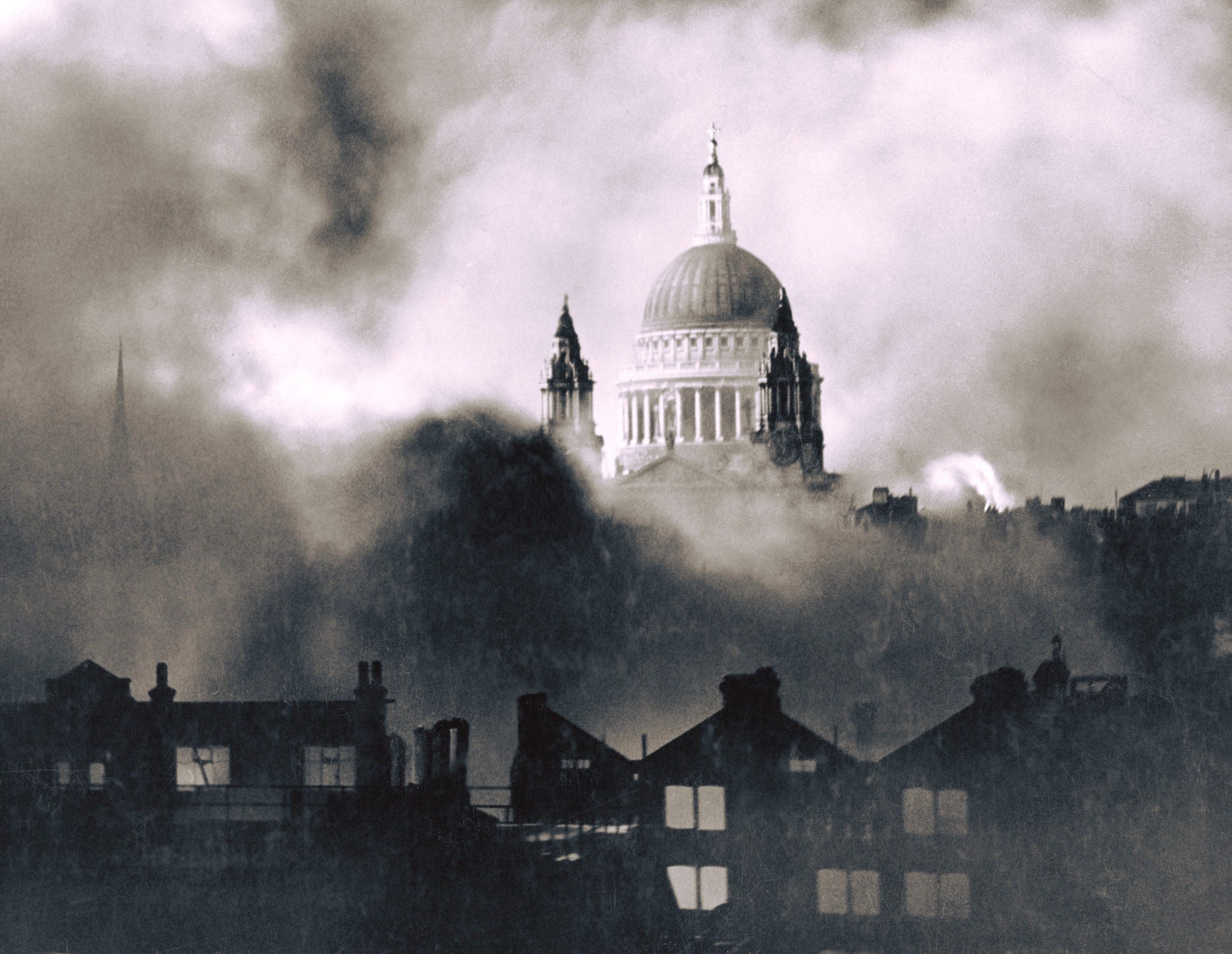
From 18.15 on the 29th December until 04.00 on the 30th, the Luftwaffe’s firebombs rained down on the capital, causing fires over an area greater than the Great Fire’s flames in 1666. Unlike the first conflagration, Londoners had taken to sleeping in Underground stations or their air-raid shelters on this, the 114th consecutive night of bombing somewhere in Britain. Preparedness, urged by all government ministries, saved lives.
The 29th December was cold and a clear moonlit night. Perfect for bombing. Perfect for incendiary devices and parachute bombs. Within fifteen minutes, London’s financial centre, The Square Mile, was in flames. Banks, offices, warehouses and homes were threatened or destroyed. It was the same area that had been incinerated in 1666. Still, Churchill ordered that St Paul’s Cathedral should be protected at all costs as a symbol of hope to the nation that we would not be defeated.
But just like in the Great London Fire, water supplies for fighting the conflagration had been badly hurt. The water mains had been bombed and although the River Thames was used to fill the fire hoses, the Thames was at low ebb. Dozens of unexploded bombs lay ticking away in its mud. The brave ARP wardens, firewatchers and firefighters battled the bombs as well as swirling embers and debris that night.
Volunteer firewatchers patrolled regularly, carrying sandbags and water pumps. At 2100, when an incendiary device lodged itself on the roof of St Paul’s, the lead of Christopher Wren’s magnificent dome began to melt.
But Britain – the last hope island of free Europe – would not be defeated. Just as Queen Elizabeth I said after the unbelievable victory against the immense enemy force of the Spanish Armada in 1588, ‘God was English that night.’ The firewatchers saw the bomb melt through St Paul’s roof and fall to the floor of the Stone Gallery. They rushed to smother it with sandbags.
One fireman, Sam Chauveau, told the BBC Home Service, ‘By the time we finished tackling the fires on the roof of the [Stock] Exchange, the sky, which was ebony black when we first got up there, was now changing to a yellowy orange colour. It looked like there was an enormous circle of fire, including St Paul’s churchyard.’
Ernie Pyle, the folksy American roving correspondent who later died in battle at Okinawa was an observer that night in London and wrote:
‘Into the dark shadowed spaces below us, while we watched, whole batches of incendiary bombs fell. . . They flashed terrifically, then quickly simmered down to pin points of dazzling white, burning ferociously. . . Flames seemed to whip hundreds of feet into the air. Pinkish-white smoke ballooned upward in a great cloud, and out of this cloud there gradually took shape – so faintly at first that we weren’t sure we saw correctly – the gigantic dome of St Paul’s Cathedral. . . It was like a picture of some miraculous figure that appears before peace-hungry soldiers on a battlefield.’
There were 136 German bombers over London that night, each equipped with 180 incendiary bombs. An estimated 100,000 of these, only measuring twelve by three inches (30cm x 8cm) damaged tram lines and thoroughfares with embers, bricks and other rubble. A dozen firemen and 162 civilians died that night. Many of those who bravely fought the fires and survived suffered from horrific burns, eye problems and smoke inhalation.
Since then, warfare has changed a pace. Chances of London being bombed for New Year’s 2026 are pretty slim. Maybe non-existent. But threats to our way of life remain. All countries with a coast along the Baltic and North Sea face the ‘grey threat’ of the Russian Shadow Fleet – tankers originally intended to dodge Western sanctions. They are charting and lurking with intent to damage our telecommunications, power generation grid and pipeline networks.
In November Poland bought three of Sweden’s A26 compact nuclear-powered submarines – a stealthy sleek sixty-six metre sub that can deploy underwater drones, sensors or divers onto the seabed for its defence. Estonia, Latvia and Lithuania have unplugged their power systems from the Russian grid and plugged them back into the European one – three of which are underwater.
We’ve all read about the Russian Shadow Fleet’s ‘spy craft’ patrolling British waters. There have been at least eleven suspected acts of sabotage linked to it. Drones believed to be Russian have shut down Danish airports. Similar incidents have taken place in France and Germany. These hybrid attacks give plausible deniability to a Russia, desperate to weaken European support for a democratic Ukraine.
Fortunately, until now our intelligence has been excellent despite NATO’s largely reactive stance. It doesn’t take a rocket scientist or brain surgeon to figure out why NATO acts the way it does. At the risk of sounding ungrateful (which I’m not), I have a few questions for our government: When the UK was ‘on its uppers’, teetering on exhaustion and under the very real threat of invasion in December 1940, we found the resources, morale, morals and the resilience to fight back. That was before ANY material help from the United States. Could we do the same today? There have been over a thousand incidents of cyber warfare on our shores this year, most of which have been thwarted. I may be wrong, but I don’t see any Churchill on our horizons.
May 2026 bring peace to all. . . and a thoughtful, effective defence of the realm. And Europe. All the intelligence in the world is ineffective if governments pay scant attention. Happy New Year.