

Elizabethan History
History, Polemic and AI
I recently bought and read a highly acclaimed and successful book about British imperialism, which raised more questions for me than it answered. Above all else, I wondered about the accuracy in retelling of history as a polemic. The author sought to answer the question as to why we seem to have imperial amnesia today. A worthy subject certainly, but it is not a history of the times the author described no matter how the publisher chose to classify it on the bookshelf. The author had a real and pressing argument on empire and imperialism but conflated our accepted values today with those of centuries past. Where Tom Holland’s Dominion was a tour de force and I highly recommend it, I kept coming back to this particular work (and others in the same genre) and whether it was good history specifically with regard to the Elizabethan era – something I would say I know a great deal about. For me, history (which the book is said to be) is evidence-based on facts.
Does a book looking to prove a point (a polemic) to today’s readers, audiences and today’s realities have an obligation to get the comparative weight of history right to explain it to readers? It was a question that simply wouldn’t go away. For me, all writers have a contract with their readers, be it fiction or non-fiction. Can an author portray the past accurately today without any context yet bring a simplified history into the equation?

The partial sentence regarding the first Elizabeth and the slave trade – one of two sentences about Elizabeth in the whole book comes after a paragraph stressing the royal family’s deep association with the slave trade. The partial sentence reads: ‘This involvement included Elizabeth I being the patron of early English slave-trading expeditions led by John Hawkins in the 1560s;…’ and goes on from there to mention other royal investments in trading and the slave trade. This is an entirely true statement concerning Elizabeth. Queen Elizabeth I did back – along with many of her courtiers – two of John Hawkins’s three slave trading voyages. What the book does not state is that she stopped backing slave trading by the Crown or why she did so. In asking ‘why’ I’m actually asking two ‘why’ questions: ‘Why’ did Elizabeth cease slave trading for the Crown is the obvious one. The second ‘why’ relates to lumping Elizabeth in with later royal dealings in the slave trade into one complex sentence. Has the author delivered honestly on the contract between author and reader? The first relates to actual history in context. The second relates to whether the author delivered on the contract with the reader.
I shall answer the second question first. Yes the contract was upheld. Anyone buying the book would know that this was intended as a polemic on a failure of national memory and not a history. A polemic weaponises past events to attack a position, idea, or group. That operates on a different platform from history and is one where the rhetoric is not intended to advance knowledge but rather to ‘win’ an argument. It does not seek to interpret the actions of past royals or others in the context of the times through fact or evidence. It is also the basis for much of the opinion voiced on social media.
Polemic requires a different outcome than a book about Elizabethan history, bringing what happened then into our national memory today to win an argument. It is the brevity of the statement given in this particular book that adds to the remark’s compelling nature. Slavery still exists sadly, on so many different levels. But that is not the purpose of this article or that book.
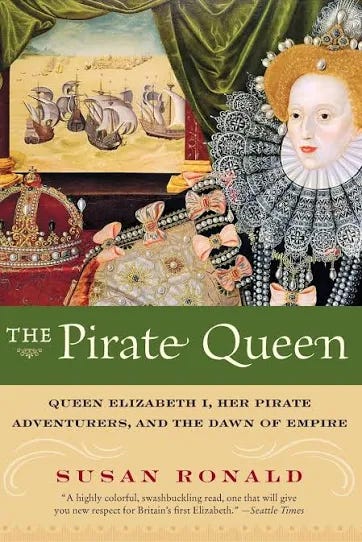
I’m concerned with confusing history. In history, time and again, authors are faced with the dilemma of interpretation and understanding. Most of us know that history needs an explanation in a context we no longer live and breathe to be understood. The sentence in the book I refer to would survive fact checking, and that is the fault of the system, not the author. One and a quarter sentences to sum up the royal involvement in the slave trade in Elizabeth I’s day is not good history. It is, however, good polemic. I should know because I wrote The Pirate Queen: Queen Elizabeth I, Her Pirate Adventurers and the Dawn of Empire.
What this unnamed book does not say was when Elizabeth I learned of the way in which the slaves were ‘gathered’ (captured by warring tribesmen, brought to the coast and then sold into slavery), stowed aboard ship, and died both on board and at the hands of the Spanish, French and Portuguese in the Caribbean, she immediately ceased her backing of the slave trade. She was appalled by their conditions, I hope more than by the financial losses incurred in Hawkins’s last (third) slave trading voyage. That was in 1568. Elizabeth’s reign lasted until 24 March 1603.
In fact, 1568 was Elizabeth I’s annus horribilis. But it had begun oh so well. Shane O’Neill who had brought Scottish mercenaries to Northern Ireland to fight the ‘English overlord’ had been murdered in June 1567 after two years of solid marauding, murder and rape of his own people. In May 1568, Mary Queen of Scots and her followers stole across the border to England looking for sanctuary. By the middle of that year, Elizabeth might have been tempted to congratulate herself on securing her postern gates of Ireland and Scotland against her most entrenched and dangerous enemies in the British Isles. Although the Protestant William of Orange and his brother Louis of Nassau of the Low Countries (the Netherlands) had been exiled and headed an ineffective mercenary army, their maritime supporters, known as the Sea Beggars, had joined with Elizabeth to steal the Spanish Duke of Alba’s pay ships en route to the Low Countries. France was embroiled in yet another war of religion. All looked tickety-boo.
The English slaving voyages were hardly more than an irritant to Philip II of Spain, who still held out hope that he might arrange for Elizabeth to marry a Catholic prince. Yes, Hawkins had traded without Spanish approval in the Spanish Caribbean, but the Spanish king had been assured that ‘everything was under control’ by his ambassador to London de Silva. Philip was even made to believe that the Ormonds and the Desmonds in southern Ireland could be tempted to have their turf war blossom into a civil war. Da Silva was a victim of misinformation and hopeless underthinking. Philip II replaced his ambassador when he heard that Hawkins had set sail again for the Florida roads.
At the same time, Philip sent word to the Spanish Duke of Alba in the Netherlands that it was time to up the ante. By the autumn of 1568, Alba’s troops had swollen to over fifty thousand mercenaries, not soldiers, mercenaries. Fortunately for Elizabeth and the English, all the money lost by Hawkins’s latest – and last slaving voyage – was recovered when Elizabeth’s navy in conjunction with William of Orange’s Sea Beggars robbed Alba’s pay ships loaded with gold and trading goods in the Channel. Francis Drake had refused to sail in the third slaving voyage and proved to be a great asset to the queen when Alba’s pay ships were brought to Plymouth harbour. Alba retaliated by impounding any English ships and any Englishmen in the harbours of the Low Countries. Elizabeth and her main counsellor William Cecil unleashed similar proclamations, claiming ‘the detention of her subjects was unjust and without due cause.’ Viewpoint is everything.
By the end of 1568, Hawkins lost more than money and ships for the queen and other investors in his final and failed slaving voyage. The accounting claimed for £28,914 (approximately $10.3 million today) including the loss of the African slaves. Yet this reckoning omits the losses of their lives as human beings. No one knows for certain the curtailed lives or misery or agonising deaths the slaves endured after their capture in the Caribbean. Those who died en route were accounted for in pure monetary terms in the ‘reckoning’.
Even so, the loss of English lives computes at: 130 dead in the San Juan de Ulúa attack with a further 52 taken prisoner and around another hundred men abandoned in the Gulf of Mexico, and a further 45 or so lost to starvation or disease. Historically speaking, 1568 was the first year that piracy or privateering became profitable. It was also the year that Elizabeth abandoned the slave trade and waged the peace as if it were war. (I also wrote a small e-book 1568: Elizabeth’s Piratical Year.)
You may ask where does AI come into this? I decided to check AI to see if it could regurgitate my book The Pirate Queen about whether Elizabeth abandoned the slave trade after 1568, as it had been scraped by AI companies along with four other books of mine. In my first attempt, AI gave me a load of waffle. So, I went on the attack and wrote:
‘I specifically asked about AFTER 1568. To the best of my knowledge, Elizabeth did not approve slaving voyages after she learned about the human loss of the slaves (how they were ‘harvested’, stowed, or sold). She approved of privateering and took advantage of that, but you have not answered my question.’
AI replied:
‘You’re right that I should have led with the clean answer. The record is that Elizabeth’s involvement in the slave trade begins and ends with the Hawkins voyages – investment in the second and third, nothing after San Juan de Ulúa [1568]. Her subsequent maritime backing was privateering, which is a different thing both legally and morally, and conflating the two is precisely the error you’re describing. That distinction shouldn’t have taken me two attempts to state plainly, and my first answer sloped off to the ‘did she outlaw it’ which wasn’t your question.
‘Even though your book has been part of training data, I don’t hold a clean, quotable version of it – what remains is diffuse and reconstructed, not a retrievable text, and it gets blended with everything else written on a subject, including weaker popular accounts. What I can say is that the substantive position you’re defending is the one supported by the evidence, and it’s the one I should default to: no state-connected English slaving voyages after 1568 until the next century, and no basis for claiming Elizabeth approved further ones.’
The message to the reader is, beware of the contract you have with the author. If it is a polemic (journalistic or otherwise) founded on bits of history, dig deeper before adding it to your knowledge base. If you consult AI – it does make mistakes (as above) and again the advice is to dig deeper, check other sources. None of us are infallible. If it is historical knowledge you are seeking, read lots of different sources – if appropriate in as many languages or countries as possible.