

When I was writing my book Hitler’s Aristocrats: The Secret Power Players in Britain and America Who Supported the Nazis, 1923–1941, it was important for me to read Dorothy Thompson’s articles (1921–1945) and re-read Sinclair Lewis’s It Can’t Happen Here (1935). For me, no one portrayed the harm the Versailles ‘peace’ caused Europe better than Dorothy. And nobody could hold a candle to Sinclair Lewis’s shedding light on ‘small town’ America. Together they were a force of nature.
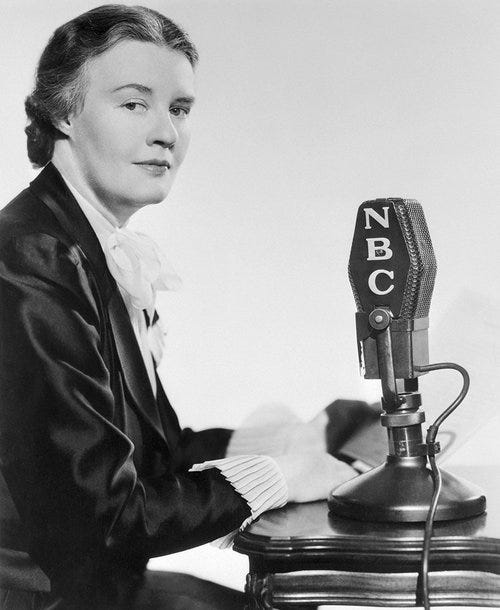
(Dorothy Thompson, 1937. She was the most important influencer against fascism in America)
Dorothy was once described as ‘a lady who would forget her pyjamas’, but she sure knew how to pack a punch with her words. Aged twenty-six, she sailed for Europe in the spring of 1920 with no job. She’d resolved to earn a living through freelance journalism – and made her mark from the outset. Her earliest stories dealt with Zionism and the push for a Jewish homeland, striking Italian autoworkers and Italian fascism, and the leaders of the Sinn Fein in Ireland. She always managed to be in the right place at the right time and that led to the International News Service hiring her as a stringer. In one of her first articles from Vienna in 1920 Dorothy wrote, ‘Democracy, socialism, nationalism, were all assuming new, strange forms. All traditions were disintegrating.’
Sound familiar?
Harry Sinclair ‘Red’ Lewis was brought to Dorothy’s thirty-fourth birthday party by a mutual friend, and he proposed to her that very evening. Then he proposed countless times more, even following her into the Soviet Union where she was carrying out research for her first book, The New Russia (1928). He turned down a Pulitzer prize but thought better of saying no to the Nobel Prize for literature – the first American to be awarded one.
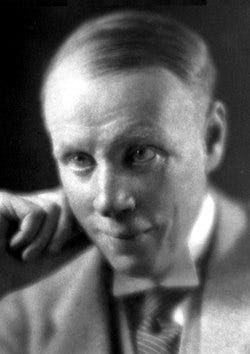
(Sinclair Lewis in 1930)
Lewis’s most enduring book, It Can’t Happen Here could never have been written without Dorothy’s input. She had her finger on the pulse of a Europe tearing itself apart as it descended into the extremes of fascism or communism. She wanted to interview Hitler ever since his 1923 beerhall putsch but failed. Still, Dorothy knew Hitler was THE story and never gave up. In October 1931 she succeeded but first ploughed through Mein Kampf. She wrote that it was ‘eight hundred pages of Gothic script, pathetic gestures, inaccurate German and unlimited self-satisfaction. Hitler attacked Jews but also ‘the dollar-chasers, the money-grubbers, the profiteers’. Dorothy wrote that ‘Hitler’s movement was going to votedictatorship in![. . .] Imagine a would-be dictator setting out to persuade a sovereign people to vote away their rights.’That piece appeared in April 1932, three months before the German elections made the NSDAP the second largest political party. Dorothy was struck by ‘the startling insignificance of this man who has set the world agog. She predicted that, ‘Unless things change radically, there will be a war in Europe within the decade caused by that ‘awkward Austrian’.
Sound familiar?
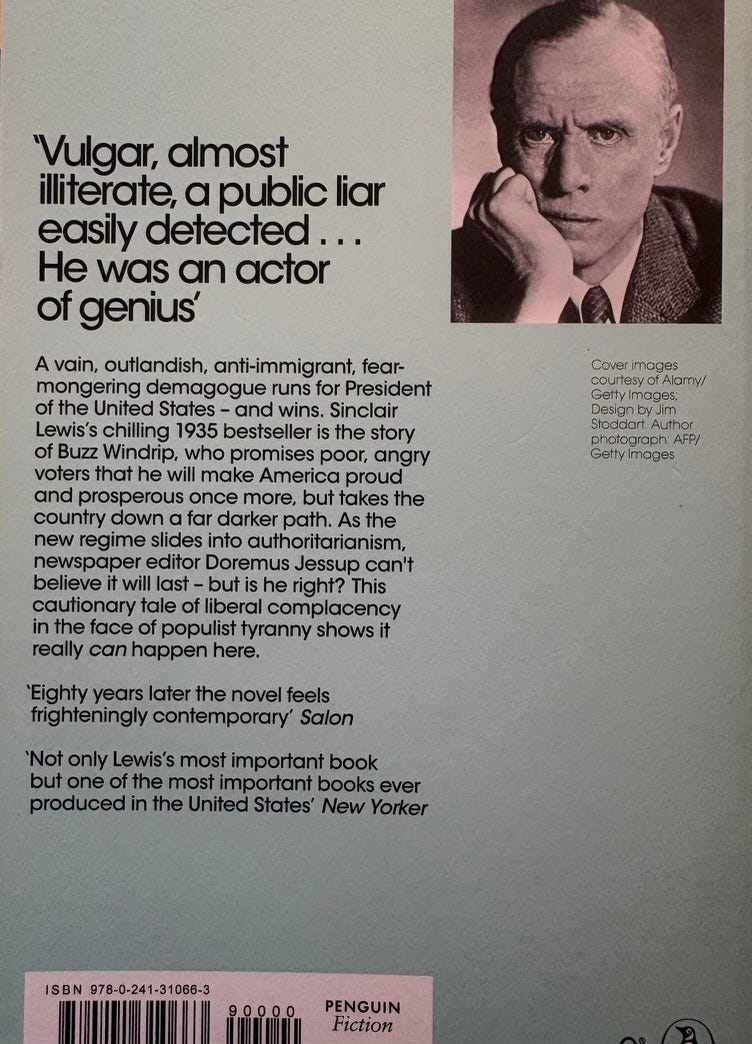
Sinclair Lewis’s great contribution to literature showed that leaders can and do betray the constitutional electorate, even in America. Originally described as ‘dystopian’ – even ‘science fiction’ – It Can’t Happen Here describes the rise of a politician Berzelius ‘Buzz’ Windrip – a demagogue who is elected President of the United States by promoting drastic social and economic reforms amid bizarre claims and fear-mongering, while espousing patriotism and traditional values. As the plot gets darker, Buzz Windrip promises every single American $5,000 a year (around $116,000 in 2025). That’s something like Elon Musk’s one million dollar offer to voters in marginal Red/Blue states in the 2024 election to vote Republican. The ‘voice of reason’ is a journalist Doremus Jessup and his opposition to Windrip’s regime in a rebellion.
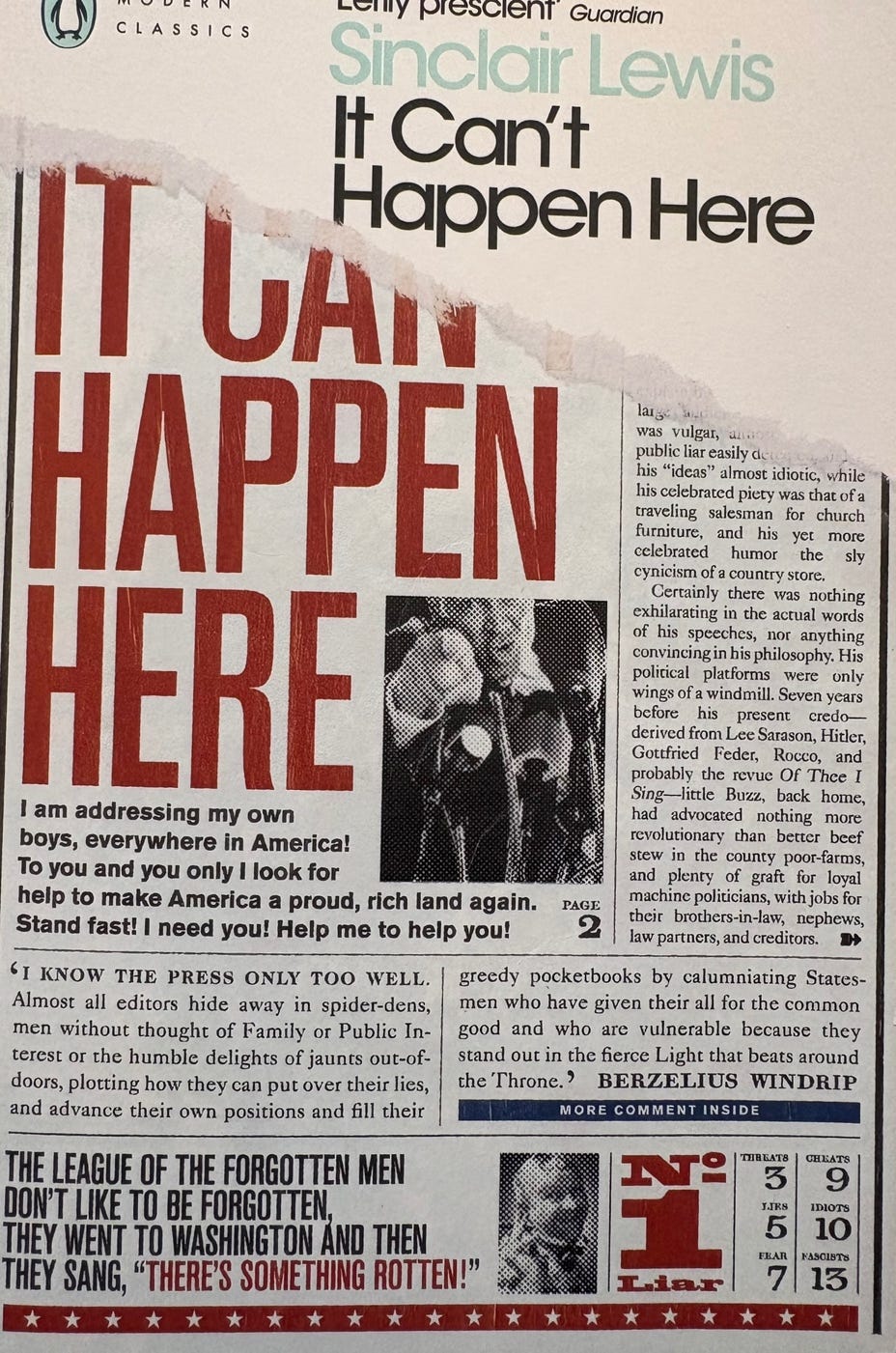
Jessup is endowed with Dorothy’s insight into the death of democracy and the betrayals of electorates internationally. Early in the book, Doremus says, ‘If Bishop Prang, our Savonarola in a Cadillac 16,[*] swings his radio audience and his League of Forgotten men to Buzz Windrup, Buzz will win. People will think they’re electing him to create more economic security. Then watch the Terror! God knows there’s been enough indication that we can have tyranny in America.’
Windrip outlaws all dissent. All political enemies are put into concentration camps. He trains a paramilitary force called the Minute Men, named after the Revolutionary War militias, who terrorise Americans, attacking peaceful demonstrators with bayonets. The influence of Congress is eliminated.
Sound familiar?
The inspiration for the character of Buzz Windrip was the US Senator from Louisiana, Huey Long. Bishop Prang was modelled on the American-Canadian radio priest Charles Coughlin who crowded the airwaves promoting Long for president in the 1936 election. To counteract Roosevelt’s popularity in promoting people out of poverty – dubbed ‘the forgotten man’ by FDR – Long created a socialist programme ‘Share Our Wealth in 1934’. Long wanted a wealth tax, wealth redistribution and believed in ‘bad actors’ – particularly Standard Oil which Long said determined US foreign policy. Fortunately for the USA and Lewis, Long was assassinated in September 1935, about a month before It Can’t Happen Here was published.
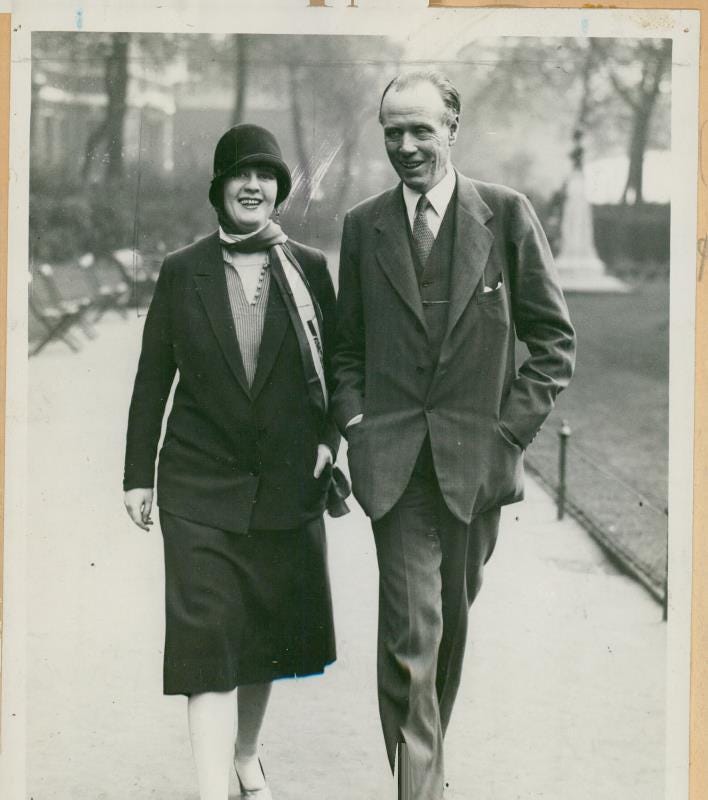
(Dorothy and ‘Red’ sometime in the late 1920s or early 1930s)
Sound familiar? It should to all Americans.
History repeats itself but never quite in the same fashion. Of course, it can happen anywhere … and it already has.
A 1990 Vanity Fair piece by Marie Brenner reported that Ivana Trump, ‘The Donald’s’ first wife said:
‘. . . perhaps in a surge of Czech nationalism, Ivana Trump told her lawyer Michael Kennedy that from time to time her husband reads a book of Hitler’s collected speeches, “My New Order,” which he keeps in a cabinet by his bed. Kennedy now guards a copy of “My New Order” in a closet at his office, as if it were a grenade.’
I heard an ABC News interview with Ivana afterwards where she claimed, ‘The Donald read Hitler’s speeches every night before going to bed.’ Of course, The Donald denied what his ex-wife said – he’d never read them. Still, he called his political opponents in Trump 1 vermin and said, ‘illegal immigrants are “poisoning the blood of our country”’. That remark about ‘blood’ goes back to the Spanish Inquisition where la limpia de sangre or the purity of blood was a primary reason for booting out the Jews.
These remarks were known before the 2016 election but didn’t make a blind bit of difference.
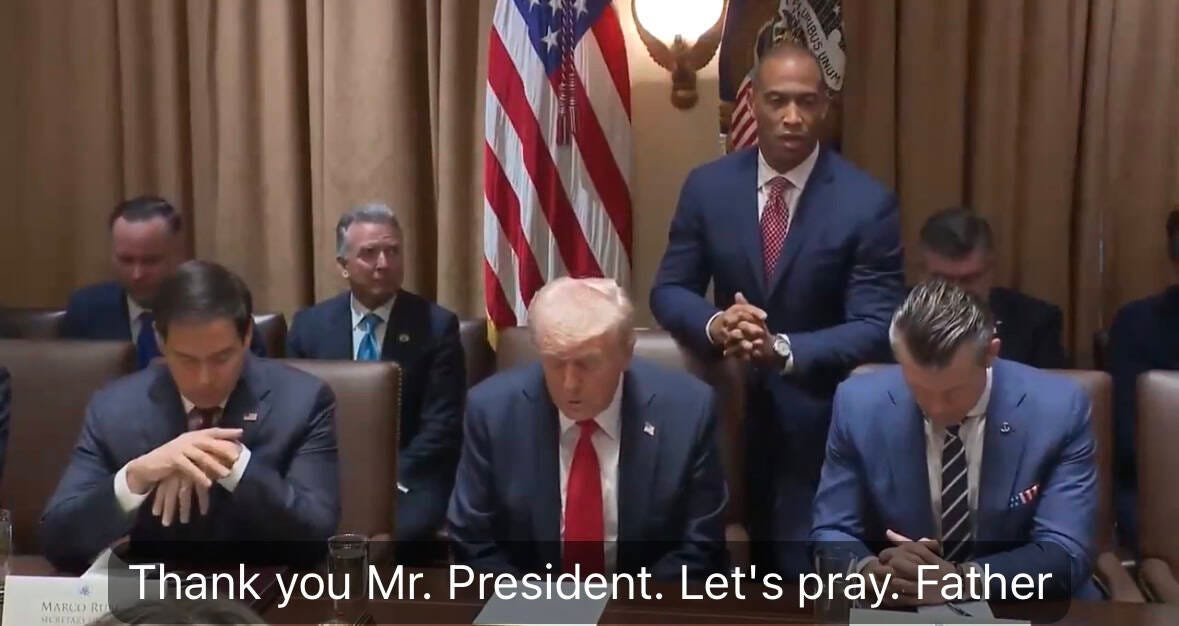
Back to It Can’t Happen Here and comparing it to Trump 2. In Lewis’s book: political enemies are put into concentration camps. In Trump 2, they are publicly shamed, sued, fired, and accused of all sorts of wrongdoing without foundation in fact or law. Freedom of expression is restricted as a result. Windrip trains a paramilitary force called the Minute Men, named after the Revolutionary War militias, who terrorise the citizens. In Trump 2, ICE, that bespoke militia engaged in duties with the public in terrifying and unacceptable consequences, depriving citizens of their rights or just killing them. . . phew. . . in Blue States. The influence of Congress is eliminated, and the Minute Men respond attacking demonstrators with bayonets. Congress? You mean that bunch of yes-men and women afraid of what the cult of Trump 2 has on them. . . ICE, of course, has already killed Americans.
A general loss of democracy, powerlessness and topsy-turvy leadership across today’s world has thrown up horrific and unpalatable consequences. The world seems haunted by nativism, ghosts of fascism, and a voting population gravitating to extremes which still – as Dorothy Thompson said in 1920 are ‘all assuming new, strange forms. All traditions were disintegrating.’
It Can’t Happen Here looks at all kinds of betrayals that friends, governments and leaders perpetrate to reduce our faith in our democracies. In the UK, some feel Nigel Farage holds the answer… seriously? Trump’s poodle? Farage is a danger to democracy. In the UK so many of us have an overwhelming sense of powerlessness and confusion – some of which is caused purely by leaders who frankly don’t seem up to the job at hand.

I’ve been shocked by the strength of feeling against this Labour government which was elected by a landslide (that is if you don’t count that it only had 33.6% of the vote) less than two years ago. Since then, U-turns have become graceless pirouettes – what number are we at today? The grifting and ministerial shenanigans has been astounding. The latest pirouette is that the UK is not in the US/Israeli war against Iran. This week I spoke to friends in the US. They still believe that the UK hasn’t allowed American bombers at their bases here. Could have fooled me – Fairford and Brize Norton (not an American base) are in full-flow. The ‘special relationship’ has vanished – save for Five Eyes.
Labour’s big word during the June-July 2024 election campaign was ‘growth’. By Christmas, the prime minister had to ask business leaders what growth meant to them.
During the outrage of children murdered at Southport in the summer of 2024, the PM was in his own words ‘concentrating on Chagos’ – that expensive deal to give the islands to Mauritius – and one which should not happen since Trump has the veto. Starmer issued orders for summary justice for demonstrators against immigrants then, but not for demonstrators (and police) issuing threats to Jews in London. There was no reporting about antisemitism and other community issues that summer in Golder’s Green even though residents were terrified. No wonder Sadiq Khan is due to receive a ‘lordship’.
A government’s first priority is to ensure that its people are safe and thriving. Access to food, shelter, health and suitable employment is a mainstream goal. A steady economy is the touchstone for feeling better. I feel betrayed that none of these ‘essentials’ are essential to this government.
In the UK, the greatest betrayal that overarches everything – including our lack of food security – is our lack of energy security. Our current ‘fuel threat’ due to the Iran War proves the point. We are vulnerable to global warming, geopolitical stresses and complex supply chains. But don’t worry, it’s only diesel. . . which we don’t like anyway that runs out in two weeks. Never mind that the bulk of our food is delivered to supermarkets in diesel-powered lorries – and that farms need diesel to tend the crops. We were once an oil exporting nation, but we have mothballed our last refinery, and any products that need to be refined are exported to the Netherlands or Belgium – then reimported here. We are sitting on the largest unexplored oilfield in the North Sea near Shetland (Rosebank) with between 300-500 million barrels of crude oil and Jackdaw gas field east of Aberdeen. Before Labour won the election in July 2024, they were licensed to begin exploration.
The energy secretary Ed Miliband whose department is known as DESNZ (or Department of Energy Security and Net Zero) cancelled the licenses. Why should he abandon Net Zero? Because it hasn’t dawned on DESNZ that the three biggest world polluters The United States, China and India keep polluting more. . and let’s not think about the extra climate pollution and misery caused by the wars in Ukraine, Israel/Gaza and Iran to the only Earth we have.
But the UK will have its Net Zero. . . even though we’re a pimple on the gas-guzzling map.
Yes we should be less dependent on a complex international supply chain, but Miliband’s thinking is cockeyed. An adequate infrastructure is necessary before his change can be achieved, meaning the grid needs to be updated. The new NPPF (National Planning Policy Framework) has downgraded the importance of the environment – you know that thing that helps all life on the planet breathe and feel good. Large solar farms are contributing to our lack of food security (56% of our calories consumed are from imported food). Large solar farms also use the best and most valuable land taking it out of food production . . . but Net Zero remains intact. Sadly, not ‘energy security’ which is also in the title of his department.
Miliband is blind to the ‘big picture’. . . and aside from the bacon butty there’s a good reason why. Lately MPs ‘special advisors’ or SpAds have been in the headlines, like Starmer’s Morgan McSweeney. Ed Miliband’s SpAds are from Extinction Rebellion:
Tobias Garnett: Miliband’s chief of staff and formerly legal adviser to Extinction Rebellion. He was the legal strategist at XR who led the group in a crucial High Court case ruling that the Metropolitan Police’s ban on their protests was unlawful covering the period when activists were supergluing themselves to planes and jumping on Tube trains.
Jonty Leibowitz: has policy interests that include arguing for socialist reforms to football, including a 100% tax on transfers from abroad. (Is that a government priority??) On his energy brief, he has written a policy paper arguing that regional banking should be forcibly re-oriented to financing the energy transition.
The third SpAd is Eleanor Salter. She focuses on ‘integrating nature into the climate offer’ (repeat please in plain English?) and has argued that tackling climate breakdown requires ‘taking many cars off the roads altogether.’ She has also called for a ‘right to roam’ across the countryside to challenge what she describes as vastly unequal land ownership. (I wonder how the ‘roamers’ will get there without cars.) Her salary is half paid by DESNZ and half by DEFRA which answerable to the Secretary of the Environment, Emma Reynolds.
It is little wonder that there was a shudder across the UK when the prime minister said at PMQ that any decisions on energy were down to Miliband by statute. Kemi Badenoch reminded him that the unions agreed with the Conservatives as did the energy providers and think tanks. He took that as a personal attack rather than listening properly.
To my mind, building a functional society is like making a painting or any picture. You prepare the ground carefully. You sketch out the effects of one part on the other and change things accordingly. You add layers little by little, or take them away, to support that foundation and eventually you have a working creation fit to admire. You have to do the same to change a whole society, one that is fit for the future.
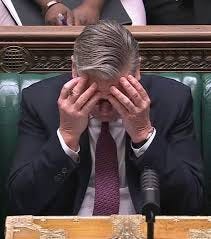
So, here’s a picture from this week. No, he’s not praying. It has happened here.
[*] Giolamo Savonarola was the ascetic Dominican friar who preached in Renaissance Florence in the 1490s.