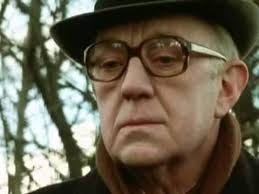
In the screenplay adaptation of John Le Carré’s 1979 book Smiley’s People George Smiley is likened to a ‘rogue elephant’ by the head of the Circus, Saul Enderby. It is an unfair assessment since a rogue elephant is a panicked unstoppable force that if seen on the rampage means you must kill him or to get out of the way. The unflappable Smiley says in Episode 4 of the same title:
‘In my time, Peter Guillam, I’ve seen Whitehall skirts go up and come down again. I’ve listened to all the excellent argument for doing nothing and reaped the consequent frightful harvest. I’ve watched people hop up and down and call it progress. I’ve seen good men go to the wall and the idiots get promoted with a dazzling regularity. All I’m left with is me and thirty-odd years of cold war without the option.’
A perplexed Guillam asks, ‘So what does that mean in little words?’
‘It means that if a rogue elephant, to use Saul Enderby’s happy phrase, charges at me out of the thicket of my past and gives me a second shot at it, I intend to shoot it dead – but with the minimum of force.’

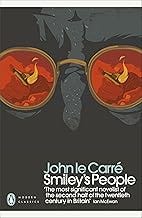
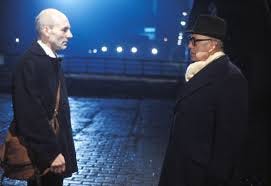
Both the screenplay and the book are masterclasses in how to create atmosphere, texture and pathos in a fond farewell to both George Smiley and Smiley’s Professor Moriarty, the ever-silent and seemingly superior Russian spy chief, Karla, played by Patrick Stewart. For the first time in Smiley’s career, he becomes an active agent – as well as the mastermind behind the desk – and he senses he has the upper hand at long last against his chief adversary. Le Carré writes:
He was in late age, yet his tradecraft had never been better; for the first time in his career, he held the advantage over his old adversary.
On the other hand, that adversary had acquired a human face of disconcerting clarity. It was no brute whom Smiley was pursuing with such mastery, no unqualified fanatic after all, no automaton. It was a man; and one whose downfall, if Smiley chose to bring it about, would be caused by nothing more sinister than excessive love, a weakness with which Smiley himself, from his own tangled life, was eminently familiar.
Most unusually, the protagonist (Smiley) and antagonist (Karla – who is more alive in Smiley’s mind than on the page) share character traits that are sympathetic. For Smiley, his relentless pursuit of Karla is both personal and political. Smiley tells his wayward wife Ann of his mission, ‘It’s to do with the people who ruined Bill Haydon.’ But Bill Haydon was long dead when they have this ‘talk’. It is devastatingly understated, as all of Smiley’s excruciating emotional pain regarding his excessive love for his philandering wife. Smiley thinks of Haydon – a man who was esteemed by everyone as he betrayed them. He means Haydon was the man ‘who ruined you’ Ann. As the reader/viewer, we’re thinking ‘who ruined us.’ Later, waiting to see if Karla will take ‘the last step’, and defect to the West to protect his schizophrenic daughter, Smiley thinks through the case against him:
. . .he thought of Haydon and his own life’s work ruined; he thought of Ann, permanently stained for him by Karla’s cunning and Haydon’s scheming embrace. He recited in his despair a whole list of crimes–the tortures, the killings, the endless ring of corruption–to lay upon the frail shoulders of this one pedestrian on the bridge. . .
Karla approaches and walks with a limp. He hesitates just before he crosses into West Berlin. Guinness as Smiley makes the wait is excruciating, silent and slow. You want Smiley to succeed, yet you know that if he does, it is the end of both his marriage and how he views himself. Guinness as Smiley exerts an overpowering self-control, where his only emotion is taking off his glasses and cleaning them before placing them back on his nose. Smiley is ‘a humane and decent man caught in the net of events beyond his understanding or control.’ In the service of his country, he has been reduced to ruin another man by using Karla’s ‘one great love’ – a daughter – against him. Smiley had been driven throughout his career by Karla’s devotion to the Russian Soviet Union, a tyrannical state, without thinking of him as a man with the same thoughts, fears, and overpowering love for one person. He understands that his excessive love for his wife and Karla’s excessive love for his schizophrenic daughter are one and the same weakness.
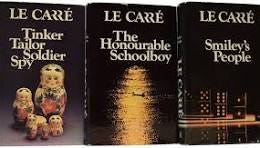
Smiley reflects that Karla’s service to a totalitarian state ‘at least gave point to the perpetual chaos that was life’s condition; point to violence, and to death; … Karla, for whom killing had never been more than the necessary adjunct of a grand design.’
What is so excruciating at the end of the Smiley novels and television adaptations starring Guinness is that George Smiley had always thought of himself as an honourable man, hampered and at times humbled by his own ‘doubt and sense of decency’. So did we. However, only Smiley realises that his victory over Karla – a man also flawed by his humanity – was more fanatical about his one love than his devotion to his country.
Worse for Smiley, without Karla, how could he see himself any longer as ‘a decent man’? Knowing that if he wins this final game, there is no longer any difference between Karla and himself since he has: ‘destroyed him with the weapons I abhorred. . . and they are his. We have crossed each other’s fronters, we are the no-men of this no-man’s-land.’
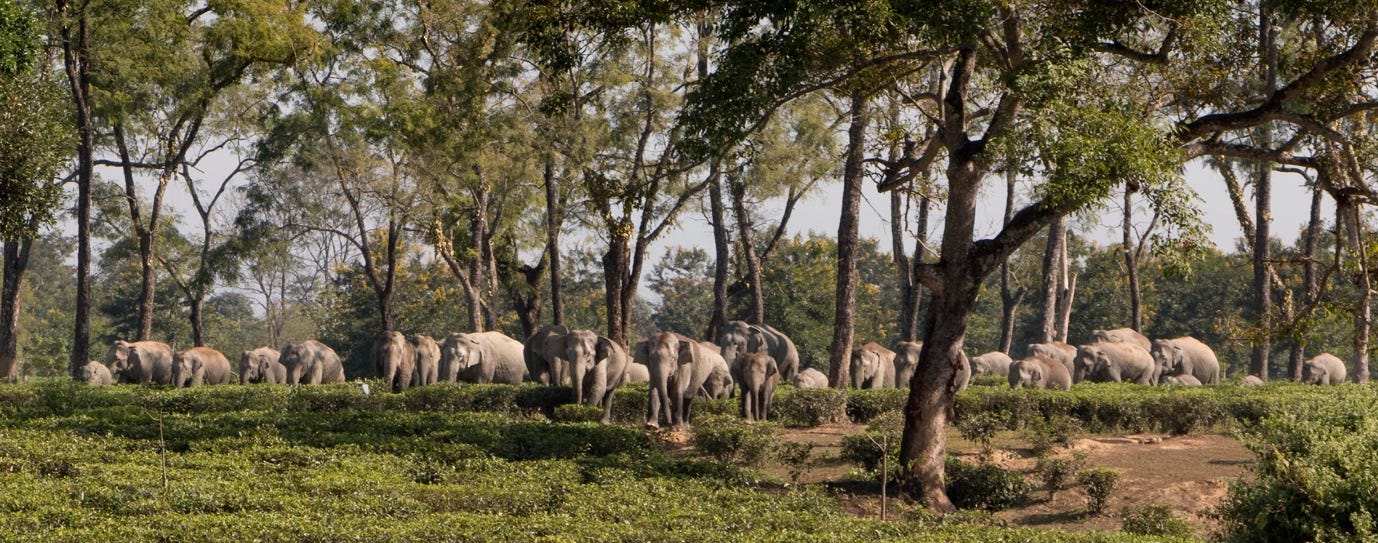
The slow-moving, considered and considerate George Smiley hardly fits the American Merriam Webster definition of rogue elephant: ‘a vicious solitary bull elephant that has separated from its herd, known for unpredictable, aggressive, and sometimes lethal behaviour toward humans and infrastructure. These animals often emerge due to habitat loss or injury, exemplified by historical cases like the ‘Osama bin Laden’ elephant in Assam.’ In fact, Smiley is more like the graceful slow-moving peaceful herd pictured above grazing within the Assam tea gardens than the rogue elephant below.
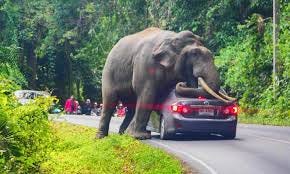
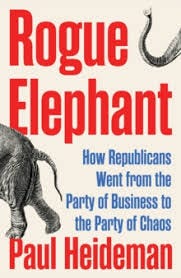
A rogue elephant is unpredictable, aggressive and aims to destroy. Wait. . . isn’t the elephant the symbol of the Republican Party? Well, yes. The rogue elephant is the Republican Party under Donald Trump – as well as the proverbial elephant in the room. In his November 2025 book, Rogue Elephant: How the Republicans Went from the Party of Business to the Party of Chaos, author Paul Heideman argues that the election of Donald Trump (not once but twice) is no anomaly but a steady progression over fifty years. It offers a new perspective on men like Newt Gingrich to George W. Bush, the Koch brothers and Trump, and demonstrates ‘that the party’s lurch to the far right was the product of a volatile mix of a disorganized party structure and a divided and fractious class of American business owners.’ There is a great deal to commend this interpretation.
However, Donald Trump has taken matters beyond a well-defined chaos. He has made the US government a ‘business’ in its own right. Aside decimating government departments, free speech, and ignoring the right to privacy, he’s made a grab for the world’s oil supplies in Venezuela and Iran. He has charged a ‘government fee’ of 70% of the acquisition price to the new investors of the US-branded TikTok. In business mergers and acquisitions, it’s rarely over 3%, and never ever 70% or $10 billion. Trump sees ‘saving’ TikTok and handing it to that ‘same fractious class’ of Rogue Elephant of American billionaires in the only light he understands: a business deal.
Trump America has taken things beyond the pale. But Uncle Sam has been transactional from the time it first burst onto the world stage during the Great War of 1914–1918. (It could hardly be called the First World War if the Second World War hadn’t yet taken place.) In both cases the USA was late to the ‘party’. President Wilson came to Versailles determined to make his Fourteen Points and the League of Nations the new world order. Wilson had Morgan Bank advising him to insure that any reparations or rebuilding of the spent European economies would be made by a consortium of American banks led by Morgan. The US Senate had other ideas and left Europe with a League of Nations devoid ‘American leadership’ by turning down the president’s brainchild. (Do read Ron Chernow’s stunning book House of Morgan and Margaret MacMillan’s Paris: 1919 to really understand the roots of the Second World War.)
A real rogue elephant in the wild is dangerous, uncontrollable, and frankly needs to be captured, imprisoned or shot to save those who are threatened. Ask anyone who has come across the ‘Bin Laden’ rogue elephants in Assam or other ‘Laden’ elephants elsewhere. The ‘rogue’ is isolated from his usual society – his herd – and the infrastructure it lives comfortably within. Its habitat has been invaded by humans, and it rampages out of control.
Sound familiar? So, too, is the US Secretary of State for War, Pete Hegseth, revelling in ‘Death and destruction from the sky all day long,’ he screams wearing a red, white and blue tie and pocket square, as he spits his vitriol. ‘This was never meant to be a fair fight, and it is not a fair fight. We are punching them while they’re down, which is exactly how it should be.’ But publish an unflattering picture of Hegseth, and you’re banned from his Pentagon briefings.
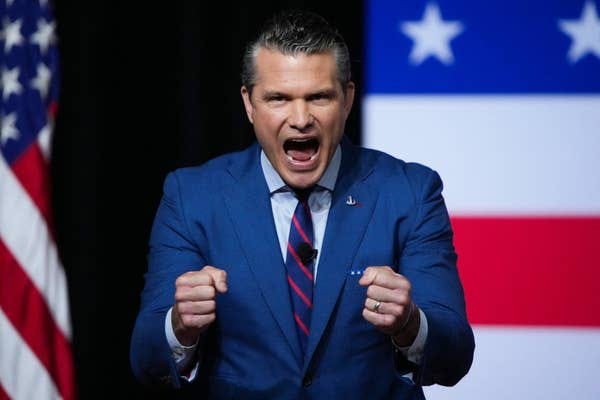
(Image: Andrew Harnick: POOL/AFP)
In war, I acknowledge it is never right to fight with one hand tied behind one’s back. But give me a real Statesperson please, not men with no combat or international espionage experience at the helm. Give me a modern-day real George Smiley who regrets destroying his enemy, a man, by using the enemy’s tactics. Smiley understood that in fighting dirty, he had lost what he treasured most: his humanity.