

As an historian and writer, I’ve learned that context matters when quoting from original sources. Always ask yourself, what did that person or character intend by their simple statement? In literature, as in life, how a quote is used or misused changes our understanding and is used as an effective tool to keep us in ignorance or twist the truth.
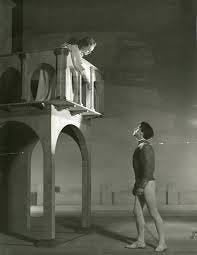
Take for instance the simple statement made by Juliet in Shakespeare’s Romeo and Juliet: ‘Wherefore art thou, Romeo?’ Most people today think of this phrase in the modern context of ‘where’ and see Juliet standing on her balcony asking, ‘where are you hidden?’ The quote is correct, the understanding is not. Wherefore today means ‘for what reason’ or ‘as a result of which’ in dictionary terms. When those words were written, the meaning of wherefore was simply why. Juliet not asking where are you hiding Romeo, but why Romeo is your name Montague when they are feuding with us Capulets.
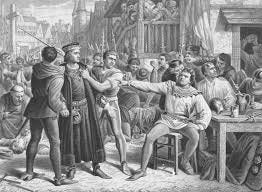
Similarly, when Dick the Butcher says in Act IV, Scene II of Shakespeare’s Henry VI, Part II, ‘The first thing we do let’s kill all the lawyers’ we – quite understandably – have interpreted this much-vaunted phrase literally. (At least that’s what many of us think if we’ve ever had complex and costly dealings with them.) But that was not Shakespeare’s intended meaning.
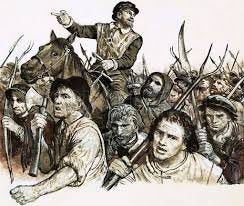
The words kill all the lawyers came out of the mouth of a follower of Jack Cade who led a popular rebellion in 1450 against the government of Henry VI for maladministration and rampant abuse of power by the king’s closest advisors and corrupt local officials. The dialogue in context, as spoken by the rebels is treasonous:
JACK CADE: Valiant I am.
SMITH [aside]: A must needs: for beggary is valiant.
JACK CADE: I am able to endure much.
DICK [aside]: No question of that; for I have seen him whipp’d three market-days together.
JACK CADE: I fear neither sword nor fire.
SMITH [aside]: He need not fear the sword; for his coat is of proof.
DICK: [aside]: But methinks he should stand in fear of fire, being burnt I’ th’ hand for stealing of sheep.
JACK CADE: Be brave, then; for your captain is brave, and vows reformation. There shall be in England seven half-penny loaves sold for a penny: the three-hoop’d pot shall have ten hoops; and I will make it felony to drink small beer: all the realm shall be in common; and in Cheapside shall my palfrey go to grass: and when I am king, – as king I will be, –
ALL. God save your majesty!
JACK CADE: I thank you, good people: – there shall be no money; all shall eat and drink on my score; and I will apparel them all in one livery, that they may agree like brothers, and worship me their lord.
DICK: The first thing we do, let’s kill all the lawyers.
Treasonous certainly. Tantalising to an ignorant public trying desperately to make ends meet.
What this passage doesn’t show is how aggressively anti-intellectual Cade and Dick are and how they kill those they know can read and how they burn all the books and documents they come by. It is essential for the rebellion’s success that they take over an ignorant population who can understand their simple message of the peoples’ rights. It’s still a trick used today by he who must not be named.
Shakespeare does not advocate rebellion, but rather taken in context explains what the rebels think or thought back in 1450. Shakespeare does not wish to kill all the lawyers, for they are the keepers of the written records and the upholders of the rule of law upon which a civilised society is based.
As we all know, misquoting to suit one’s own purposes continues today, but is often (at least in a British context) artfully disguised. Let’s take for example barrister David Lammy, Deputy Prime Minister’s statement in June 2020:
‘Criminal trials without juries are a bad idea. You don’t fix the backlog with trials that are widely perceived as unfair.’ He also said that jury trials are ‘a fundamental part of our democratic settlement’ and praised juries as the ‘success story’ of the justice system and the strongest weapon against racial bias.
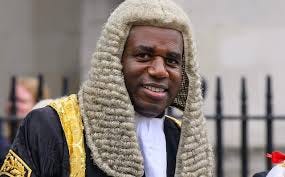
(BBC News photograph)
Naturally, this statement was made prior to being a key cog in power. Suddenly, the picture changed. Eliminating trial by jury will ‘stop criminals from gaming the system’ and ‘clear the backlog’ in the courts. Please correct me if I’m wrong, but I thought if you are facing a trial, that you were innocent until proved guilty. . .
So now the world’s oldest democracy is to join the ranks of Hitler, Stalin, Franco and Idi Amin. . . where does the truth lie? Or does the truth lie. . .
Let’s look at defence – also much in the news. During the 2024 electoral campaign, Labour quoted Sir Ben Wallace, former Conservative Secretary of Defence, as saying that ‘the Conservatives had hollowed out and underfunded the Armed Forces’ as part of its rhetoric. Wallace had actually said at the Royal United Services Institute (RUSI) Conference in June 2022 citing both the Conservatives and Labour for this ‘hollowing out’:
‘For too long Defence has lived on a diet of smoke and mirrors, hollowed out formations and fantasy efficiency savings, while in the last few years the threat from states has started to increase.’
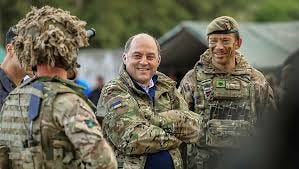
The prime minister has repeatedly misquoted Wallace. He has also misled ‘an ignorant’ public with the statement that the government would ‘spend £270 billion more than we would otherwise have done on defence’ this Parliament. Full Fact established this was incorrect. The £270 billion figure is roughly the total projected spend of the MoD between 2025/26 and 2028/29, not the cumulative increase in spending as Starmer stated. This is just one great example of Wallace’s ‘smoke and mirrors’.
Moving on. . . the prime minister has also stated that core defence will rise to 3.5% of GDP by 2035 within the past month. It was followed a day later by Chancellor Reeves’s statement which insisted that the ambition to reach 3% will only be achieved ‘when economic and fiscal conditions allow,’ and has steered clear of commenting on how the 3.5% target could ever be reached.
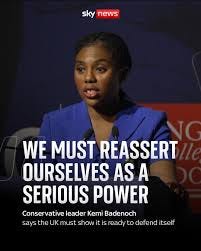
And what does Kemi Badenoch, the leader of the opposition have to say about all this? On 10 April at the London Defence Conference, she said:
‘Power does not come from speeches about values if those values are not defended by hard capability.’
Ben Wallace agrees. It’s not enough for the prime minister to say that we see you to the Russian submarines scouring the Channel to glean information to attack our tech and communication cables.
Meanwhile, the U.S. planes have stopped taking off from Fairford (for now) and (for now) the RAF Base at Brize Norton continues its exercises. How do I know? I hear them from my home.
Although the context of ‘let’s kill all the lawyers’ is inevitably used in a sense which Shakespeare never intended, we might do well to ask ourselves if ‘lawyers’ and their Special Advisors are really fit for purpose as leaders.