

About Power & Greed.
A writer’s lot is a complicated one. Faced with an embarrassment of ideas or the terror of the blank page, often the writer is unsure how to progress with that ‘grab me’ the first sentence much less a whole book. And that’s before the writer has to grapple with the overabundance of advice available for money OR free suggestions from friends OR the dizzying array of publishing alternatives MUCH LESS coping with the impossibility of obtaining an agent. The only advice I can give about writing for most people is: if you’re writing to earn a steady living, don’t give up the day job. If you’re writing because you have to, then keep going.
Fortunately, the terror of the blank page has never really affected me. That’s because before I sit down to write that first sentence, I’ve researched my subject fully, reading widely through original archival material to interviewing experts and ploughing through the latest books which might influence my book’s outcome. Writing non-fiction for publication is about what’s new and different from previously published works and why you’re the right person to write the book.
You may ask, how you convince your agent (if you have one) or your publisher. Basically, interest them with one sentence – an elevator pitch or logline. You’ve got ten seconds to hook them, no more.
It may seem incongruous to the casual observer that someone who started her writing career in non-fiction as part of a Macmillan series about what life was like in France would go on to write about a famous diamond next, then two books on unusual angles about Elizabeth I’s England, before diving headlong into the Nazi art theft and those who supported Hitler outside Germany. It all started with just one sentence. . . and a platform.
My first career in project finance and working for high-net-worth individuals and governments meant that I got a fair idea of what power and greed does to people. Since I understood that, the golden thread running through all my work has been power and greed. Voilà the platform.
What does France have to do with that? Well, I lived and worked there and spoke the language fluently. To earn money, I often translated or interpreted for business people into English. Why a famous diamond? My stepfather was in the gem trade, and I was told with my background, it was an ideal platform to enter the cutthroat world of trade non-fiction. He said find a story or a diamond or something about power and greed. Meanwhile, I didn’t give up the day job. And I learned more about power and greed.
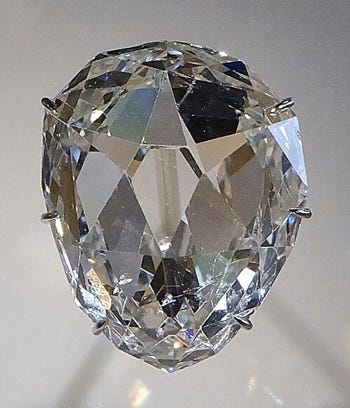
After my preliminary investigations, I settled on one of the world’s ten most famous and cursed diamonds: The Sancy Diamond. No one had traced its six-hundred-year history successfully, so that was new. My research made me the person to write it. My proposal was accepted by a publisher within two weeks. Today, the Sancy Diamond is 55.232 carats and resides in the Louvre – in the adjacent display cabinet to the Florentine diamonds that were recently stolen.
The Sancy’s cut is an odd one. It is an old rose-cut with more facets around the edges than it may have had at its beginning. Everyone who saw the stone said it was at least several hundred years old. This made it a diamond of Indian origin, probably from the diamond mines in Golconda. It was first described as being over 100 carats. I devoured the early history of trading in diamonds, what powers they were believed to hold, and who sold them into Europe. While trawling through archives, I visited Antwerp and met with one of the greatest diamond cutters ever, Gabi Tolkowsky. He was wonderfully generous with his time and over dinner explained about the rose-cut of the Sancy and gave me a beginner’s course in diamond-cutting as well as more introductions to those who might be able to help. When I met with De Beers in London, they were so taken with the Sancy’s history that they offered to buy 10,000 copies of the book as Christmas presents for its site holders.
Antwerp, Bruges, and Brussels were the first stomping grounds. Everything I read about the Sancy was sketchy post the year 1477, when it was ‘lost’ in the battle of Nancy. Its owner back then was Charles the Bold of Burgundy who wore the diamond into battle believing it would make him invincible. Neither Charles nor the diamond were endowed with superhero powers, and the Sancy disappeared for over thirty years. There were conflicting stories about who took it, but the most obvious player in the game of booty was the Bishop of Basel. So, it was off to the archives in Bern to study the inventory of stuff purloined at Nancy.
The Sancy diamond was not listed in the hundreds of pages describing the bishop’s swag. But the diamond popped up again early in the 1500s in the possession of Jacob Fugger, an international merchant banker and one of the wealthiest men in the world. It seems that Fugger had the diamond cut in half creating a second smaller diamond called Le Beau Sancy. Why would he do such a thing? Well, a 110-carat diamond is hard to wear anywhere. A 55-carat one fits snuggly in a crown, leaving the almost 35 karat ‘Beau Sancy’ in reserve for Fugger’s family jewels.
Fugger had strong connections to the Bishop of Basel. When the deal was done between them is lost to history. But Fugger definitely ended up with the Sancy – had it cleaved and recut to 55.232 carats. Then, by bigging up the diamond’s invincibility (omitting Charles was wearing it when he was killed) Fugger struck a deal with Portugal’s King Manuel the Fortunate: the Sancy in exchange for the worldwide pepper contract.
Until my research was published, there was some doubt if the Sancy had been in the Portuguese crown jewels. To answer that question, I went to Lisbon to look at Don Manuel’s death inventory. Believe it or not, I’m not fluent in sixteenth-century Portuguese, so I called in the head archivist to translate what I thought I found on the very first page. The diamond hadn’t acquired the name ‘Sancy’ as yet, but the first item in the inventory was a diamond which weighed 55.232 carats. I had followed the diamond from Golconda to its first European owner in Milan, then to Charles the Bold, the Bishop of Basel, Jacob Fugger and on to Portugal.
There would be many other owners, all of whom did not find invincibility. In fact, by the time Nancy Astor owned it from the beginning of the twentieth century, it had long been known as a cursed diamond. From Portugal, it fell into the hands of Nicolas Harlay de Sancy in 1596, a rather disreputable courtier for Henri IV of France. A lesser-known fact was that Harlay de Sancy was called the man who ‘sweated lies from every pore’ during his lifetime. By 1603, Henry IV had pledged his royal jewel collection amongst other valuables to the English in exchange for armaments so he could unite France for Catholicism. Although Elizbeth I bid for the diamond, it was James I of England and VI of Scotland who finally popped it on the front of his hat (it’s the shiny black thing that’s barely visible between the feathers below).
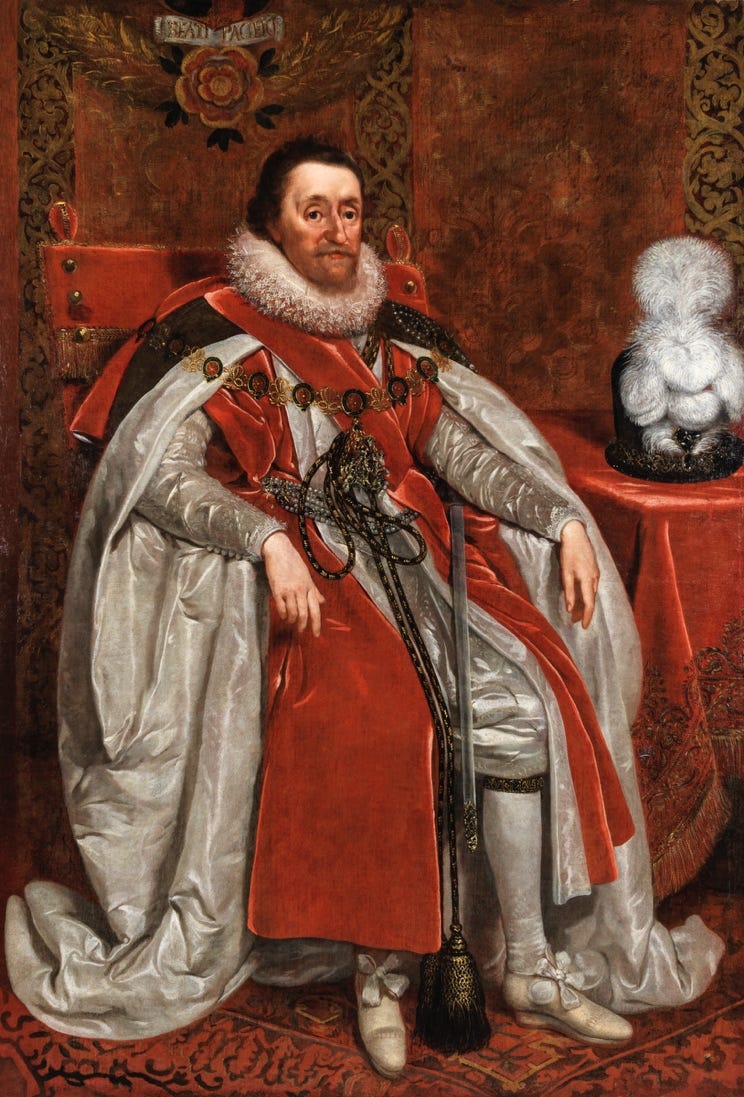
His successor Charles I gave it to his bride Henrietta Maria for her crown. When the English Civil War broke out, the queen secreted the diamond away along with other crown jewels and sold them to merchants in the Netherlands in exchange for guns, ammunition and canons to defend her husband’s crown. And so, it goes on. . . The Sancy is the only diamond to have lived in four royal crown jewel collections in its chequered six-hundred-year history crossing from India to Europe and back again several times with a brief sojourn in the United States with Napoleon’s brother.
BUT here’s the rub. After all that work, if you go to Wiki you won’t find this history (even though I wrote the article several times for them). Worse still, remember De Beers wanted to buy 10,000 copies? That was on the proviso that IF I entitled the book by the gemstone’s real name The Sancy Diamond. Well, the publisher’s marketing department insisted that I call the book The Sancy Blood Diamond: Power, Greed, and the Cursed History of One of the World’s Most Coveted Gems. I argued with the marketing director that it was more important to sell 10,000 books than to add the word ‘blood’ to the title – surely the reader would ‘get’ that it was a blood diamond from the text? Then I got the call from my commissioning editor. ‘Blood’ stays in the title or WE won’t publish.
So. . . ‘blood’ stayed. 10,000 books were not sold to de Beers, the Louvre failed to stock it in its shop. The book was rapidly forgotten. What my publisher failed to see is that I was writing a history about power and greed, and I understood what was happening to me and the book. Funny how power and greed touched raw nerves in the current day, too. My sole satisfaction comes from proving I’m a good researcher and I united the Sancy’s disjointed long history. Moving to another publisher was a bonus!