

In 2023, James Shapiro author of 1599: A Year in the Life of William Shakespeare won the twenty-fifth anniversary Baillie-Gifford Winners of Winners prize. The book had been published in 2006. In his self-effacing way, Shapiro told the American Press, ‘I hated Shakespeare in high school… I wanted to write a book for people who, like me, didn’t necessarily get what this writer and his books were about.’ One of the most important messages of that book – and from William Shakespeare too – was the importance of freedom of expression and speech. And here’s why 1599 was such a watershed:
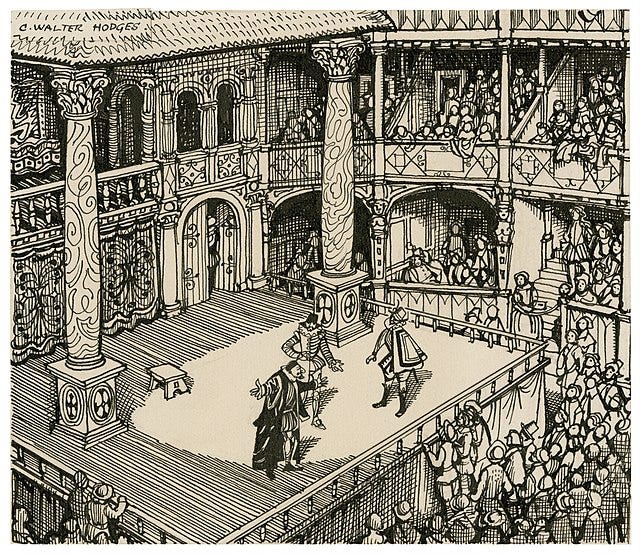
The popularity of the Elizabethan theatre in the 1570s and the proliferation of companies of players was a wondrous thing for the monarch and her court. We still reap the harvest today through some pretty astounding English Renaissance literature and we owe much to Queen Elizabeth I, her playwrights, and her audiences who always enjoyed a good spectacle. But there was a problem. The groundlings – as the poorer sort of audience were called – often got carried away with too much of a good thing, and performances ended up in brawls and other ‘outrageous disturbances’ both inside the theatres and on the streets.
Elizabeth herself was more than willing to see some representations of current political events staged, such as Christopher Marlowe’s Massacre at Paris. What she hadn’t bargained on was playwrights or pamphleteers who were openly critical of her religious settlement or the monarchy. In short, though she wanted people to learn to read, she was less keen that dissenters should learn to write whatever they desired. It was a recipe for ‘riotous behaviour’. In Elizabethan-speak that meant any strong positions against the Anglican religious settlement by both Catholics and Puritans. Although The Stationers’ Company was licensed to censor all that was fit to print since 1559, ‘outrageous tracts’ continued to find their way into print and onto the stage. Something needed to be done to regain control.
In 1589 a licensing commission tried to suppress plays altogether. Yet Elizabeth and her noblemen and women demanded that playmaking continue, both at court at her courtiers’ manor houses. Indeed, performances at manor houses were particularly valuable to the queen as players were encouraged to tell Walsingham or Burghley or other courtiers engaged in spying whether there was any seditious talk. Just one mundane example of the queen’s use of players as her spies.
Even so, the licensing commission did not give up adopting censorship as its primary function. Robert Southwell SJ had become the new voice of Catholicism in England, but late in the 1580s, another furtive writer emerged – Martin Marprelate. The name was of course a pseudonym. The ‘Marprelate tracts’ lacked the poetry and deep forlorn emotion often expressed in Southwell. The identity of ‘Marprelate’ remains unresolved to this day, but candidates abound and many believe they were playwrights like John Lyly, Thomas Nashe, and Walsingham’s favourite playwright and spy, Anthony Munday. Within short order the Marprelate tracts became raucously Presbyterian tone: unforgiving, racy – and most dangerously – written in the colloquial prose that appealed to the masses.
In a society that had just begun to recognise the significance of the printed word, the Marprelate tracts were positively seditious when performed on the stage. Edward Tilney, the Master of the Revels, became apoplectic with rage. He termed them ‘outrageous’ and unless they stopped, he intended to close the theatres. The Lord Mayor wrote to William Cecil Lord Burghley that he understood ‘that I should give order for the stay of all plays within the City, in that Mr Tilney did utterly mislike the same.’ So, a new commission was formed, including a divinity expert appointed by Archbishop Whitgift to suppress all performances. Some on the commission blamed the actors – known as players – since they would not reveal who Marprelate was. An order went out from Burghley to find the Marprelate printing press and bring the printer in for questioning before the Star Chamber. Marprelate, of course, was never found. So much for the queen ‘not making windows into men’s souls’.
By 1592 the Master of the Revels had established his licensing power over the Stationers’ and authorised plays in and about London. Yet it seemed to have little effect on the theatre-goers’ riotous behaviours. Eventually, the Aldermen of the City of London appealed to the Archbishop of Canterbury to intercede with the Privy Council. Their appeal of 25 February 1592 bears repeating in full. They wrote that the theatres provide:
‘the daily disorderly exercise of a number of players and playing houses erected within the City, whereby the youths of the City were greatly corrupted, and their manners infected with many evils and ungodly qualities, by reason of the wanton and profane devices presented on the stages. The apprentices and servants were withdrawn from their work, to the great hindrance of the trades and traders of the City, and the propagation of religion. Besides, to these places resorted the light and lewd disposed persons, as harlots, cutpurses, cozeners, pilferers, etc., who, under colour of hearing plays devised divers evil and ungodly matches, confederacies and conspiracies which could not be prevented.’
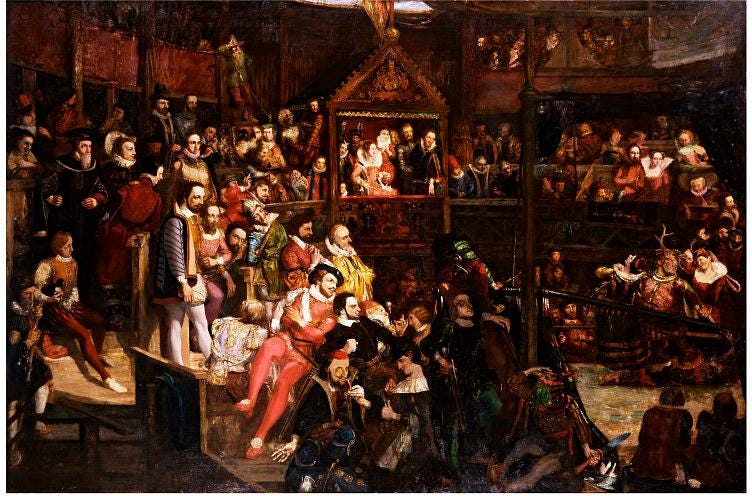
Although the Privy Council was slow to intervene, it did recognise that there was substantial truth to the Aldermen’s allegations. When the Lord Mayor reported to the Lord Treasurer that a ‘most outrageous and tumultuous’ riot had broken out in Southwark, the Lords issued an edict providing for rigid precautions against disorder in and around London which lasted from 23rd June and 29th September 1592. Lord Strange’s company addressed the Privy Council to ask that the Rose Theatre on Bankside (owned by Henslowe) be allowed to reopen. Lord Strange’s Men protested and were joined by a great many poor watermen who earned their living mostly by ferrying audiences to attend performances to and from Bankside. The players asked, what is the purpose of their roles without a performance?
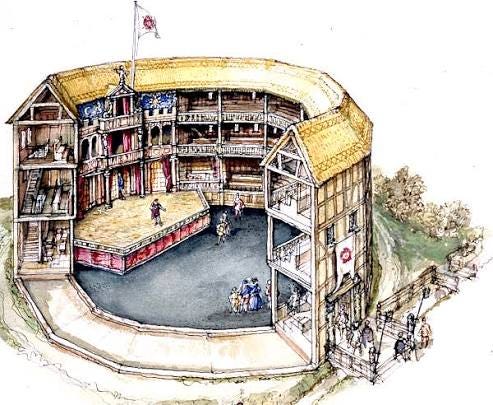
The Plague intervened to save the Aldermen from crossing swords with Lord Strange. Closing the playhouses to prevent the spread of the feared contagion was an established get-out-of-jail card everyone understood. In the spring of 1593, the Lords issued traveling licenses to the Earl of Sussex’s Men and Lord Strange’s Men to perform anywhere outside the prohibited area of the City of London. But when Lord Hunsdon – the Lord Chamberlain himself requested the Lord Major on 8th October 1594 permission for his company to perform at the inn yard of the Cross Keys in the City – the Lord Mayor could hardly refuse, and permission seems to have been granted.
Twenty days later, on 28th October 1594, the new Lord Mayor took office. A week after that, he wrote to the Lord Treasurer of the intention to build a new theatre on Bankside – probably The Swan – and prayed that this could be prevented on account of ‘the evils arising therefrom.’ Fortunately for a rising playwright called Shakespeare and all the other established playwrights and players, the Lord Treasurer ignored the request. Still, less than a year later, on 13th September 1595, the Lord Mayor was back again demanding a complete suppression of all plays ‘in and about the City’ due to ‘the disorder and crime hatched within the theatres.’ He was certainly persistent.
The threat to theatrical performance in the capital continued. In 1596, Lord Hunsdon, the Lord Chamberlain, and great friend of the players and playwrights, died. On 8th August 1596, Lord Cobham – a man of distinct Puritan leanings – took Hunsdon’s place and stringent orders were passed against theatres and players during the next few years. Evidently, ‘God’s obvious design’ – a favourite phrase of Queen Elizabeth at the time of the defeat of the Spanish Armada – had spoken. Or had he? Cobham died seven months later, four months before the demolition of the theatres was due to take place. Phew. In a letter by playwright Thomas Nashe to William Cotton that same summer, he complains that ‘the players are piteously persecuted by the Lord Mayor and the Aldermen. . . in the old Lord’s time [Hunsdon] they thought their state settled, it is now so uncertain they cannot build upon it.’
And so, the hatred of the playhouses rumbled on. Lady Elizabeth Russell, who was a patron of musician John Dowland, fought against James Burbage (father of Richard and Cuthbert) for the conversion of the Blackfriars monastery into a theatre in 1596 and nearly won. By 28th July 1597, the Lord Mayor demanded the ‘final suppressing of the said stage plays as well at The Theatre, Curtain and Bankside as in all other places in and about the City.’ The same day, the Privy Council issued a prohibition of all plays within three miles of the City during the summer until after November 1st, ‘Her Majesty being informed’ and the theatres within its jurisdiction were to be demolished. But it was not in their powers to regulate theatre-going outside the City, so the Aldermen and Lord Mayor failed. Blackfriars was not under the jurisdiction of Middlesex or Surrey magistrates, and neither were Bankside nor Southwark.
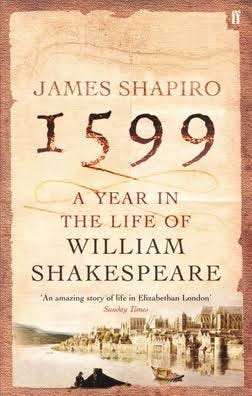
This is just some of the background as to why the fabulous book by James Shapiro 1599 A Year in the Life of William Shakespeare is so important. Shapiro takes this tumultuous history pitching the ‘new’ Puritan religion against Elizabeth’s established church into perspective, and why the theatres and all those who depended on them were under threat. The Aldermen and Lord Mayors’ Puritan beliefs threatened what has become integral to our cultural heritage. Their actions to suppress freedom of speech would have been wiped out without the bold action of the six shareholders in The Chamberlain’s Men: Richard Burbage, William Shakespeare, John Heminges, Augustine Philips and Thomas Pope and Will Kemp. Without their ‘thinking outside the box’ by these men, the seminal works of all the Elizabethan playwrights and actors may have perished in a bonfire of the vanities, never to be resurrected more than a century later by David Garrick during his Jubilee at Stratford-upon-Avon to showcase their works.