Journal ·
Hotel Exile by Jane Rogoskya
A tour de force and remembrance
I spent most of the month of October recovering from Covid. Looking to the positive side of not being able to breathe properly, it did give me time to catch up on books I wanted to read. Jane Rogoyska’s stunning book Hotel Exile: Paris in the Shadow of War was one of the first I picked up. Alexander was the second.
Hotel Exile is a rare bird on so many levels. Written in the present tense it captures you from the first page with its intimacy, the immediacy of escape, the determination of each and every person to keep doing what they love – most of whom were writers, philosophers or photographers. But she doesn’t overwhelm the reader with names. Instead, she focuses on the escape of a young woman named Gisela Freund on the first page. Gisela arrives at Frankfurt station on a cold night in the spring of 1933. That’s three months after Hitler seizes power. I don’t want to give any spoilers here, other than to say Gisela had what MI 9 called ‘escape-mindedness’ – she was a quick thinker, put herself into the SS officer’s shoes even before s saw them and knew how to lie through her teeth to survive that first encounter.
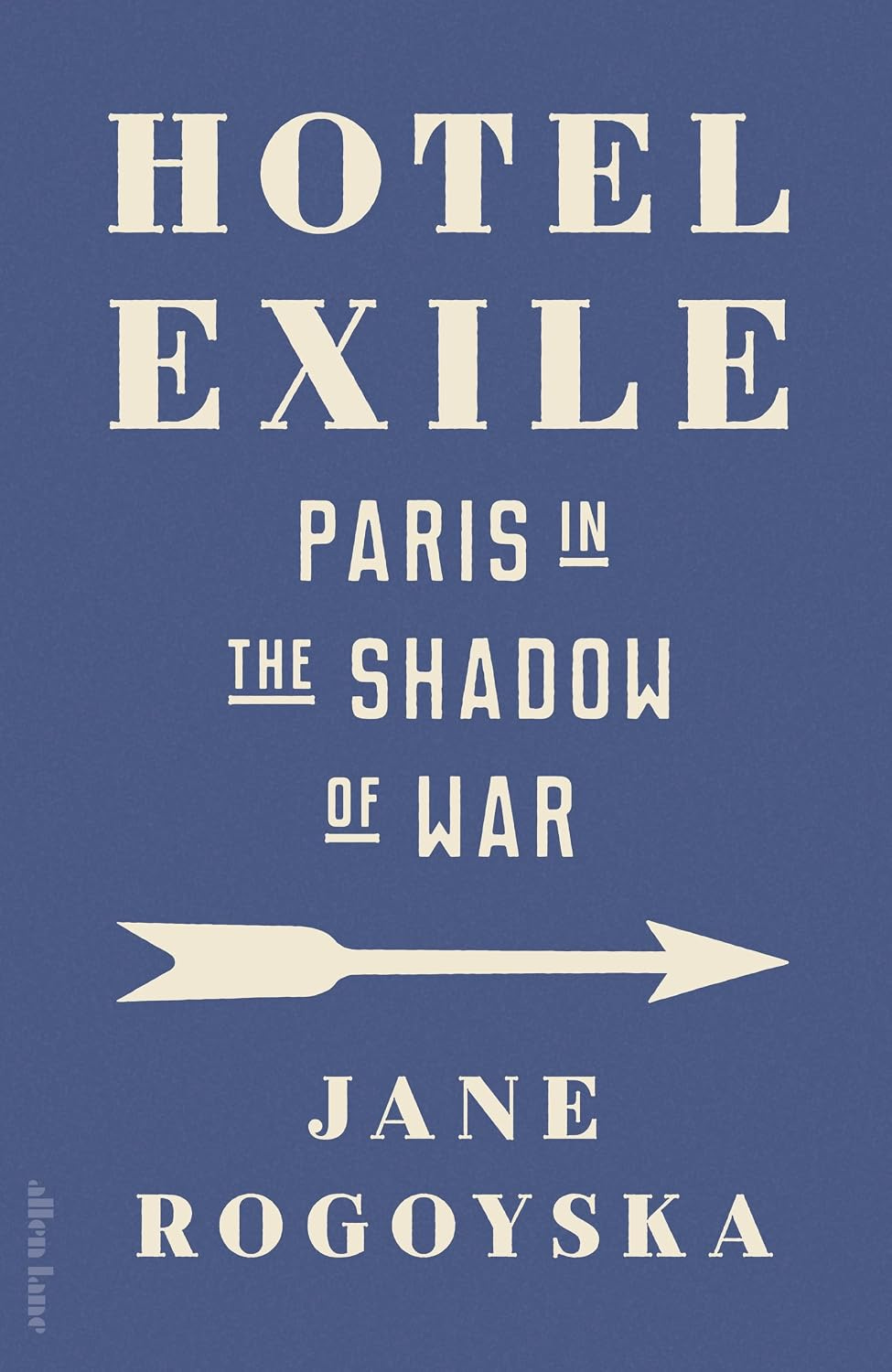
By the third page of this non-fiction page-turner, the author poses the perennial question about the rise of Hitler – which would also suit the rise of any megalomaniac hoping to erase a democracy, which the unstable Weimar republic was. She does this so eloquently, so honestly that it bears repeating here, since it underpins what happened then – and what is still happening now:
How to define the beginning of a cataclysm? Perhaps like this: a series of small, incremental changes that gradually creep up on complacent citizens, busy with lives that are at once so comfortable as to admit no possibility of change, and too filled with the personal dramas that distract us all to notice something worse. . .
On the following page, she adds:
History tells you that they should have seen it coming. Some will tell you that they did. The writing, for those who cared to read it, had long been on the wall.
In these few simple statements she cuts through all the detail of the historical wrong turns over the previous fifty years that led to the rise of Hitler. Readers agree and don’t need to know or feel ill-informed if they don’t.
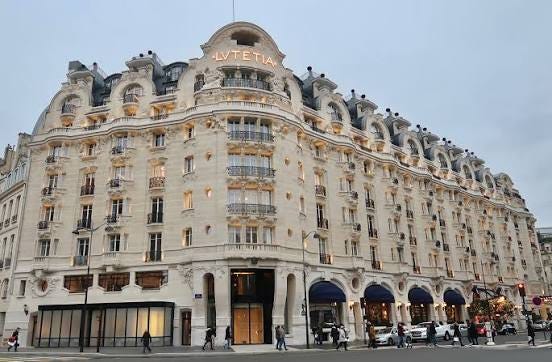
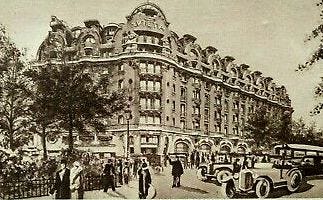
Hotel Exile is divided into three clearly defined time periods. First, the arrival of exiles to Paris who use the only ‘grand hotel’ on the Left Bank, The Lutetia, which is rightly compared to a fabulous ocean liner. They come in increasing droves from the moment Hitler comes to power in 1933. Second, there is the period during the war and occupation and finally, the aftermath. Within two years of the exiles first arrivals, the Lutetia was their preferred meeting place – if not their headquarters. Most were German political dissidents. Some were Jews. They were labelled ‘The Lutetia Crowd’ by the scornful Nazis when they took over the Lutetia during the occupation.
Actually, they were the cream of Weimar’s intelligentsia: Heinrich Mann, brother of the more famous Thomas, headed the organising committee that worked to bring down the Nazis from Paris. Since their words were banned in Germany, Mann sent his diatribes against the Third Reich back home in fake tomato-seed packets. The Communist Manifesto was rebound, too, for distribution in the Fatherland. Meanwhile, ‘The Lutetia Crowd’ these former high-powered lawyers, academics, writers, photographers shambled around Paris hoping to persuade someone – anyone – to give them work despite their shabby clothes.
By tracing the individual histories of these Nazi dissidents or resisters, the author brings us close to their trials and slowly evolving desperation in the second part of the book when the thieving Bureau Otto then the Abwehr (Nazi equivalent of MI6) take over the Lutetia. We see is not only the exiles’ lives, but understand better the Nazis, too. The portrait of Admiral Canaris, head of the Abwehr is particularly interesting. Unusually, how the average French waiter or waitress, housekeeper and hotel managers survive gives an added frisson.
It is in the third part – after the war – that this book soars to its dizzy heights. This is when we feel the inability of the returned detainees from concentration camps to speak of their ordeals. But their trauma is not over. It is telling that many felt their ‘debrief’ by those who looked after them at the Lutetia was yet another Nazi interrogation. But there is hope for some at the end of their ordeal. The most striking thing is the silence. Their inability to communicate what they had been through. Their starvation and ongoing silent search for their loved ones.
I chose Hotel Exile rather selfishly since I’m currently writing about one of the returned detainees. She does not appear in the book. She is a resister who helped Allied soldiers escape captivity before she was captured herself early in 1943. She and her friends saved hundreds of lives. She was interrogated over twenty times before being sent eventually to Ravensbrück with some of her co-resisters, before they were transferred to Mauthausen. Because she, like Gisela Freund, had ‘escape-mindedness’ she survived. Her English friends at MI 9 found her at Hotel Lutetia in May 1945 and asked her what she wanted most in the world. Tears streamed down her face. ‘Soap.’ Donald Darling – who fetched the soap – wrote about his time in MI6 and MI9 after the war in his book Secret Sunday. ‘Sunday’ was his code name. He said, ‘There was a smell of death that lingered on everyone.’
Jane Rogoskya’s Hotel Exile is a tour de force where a grand hotel deluxe is the silent central character. My husband and I went to the Lutetia shortly after its refurbishment was completed in 2018. In pride of place near the entrance is the plaque below:
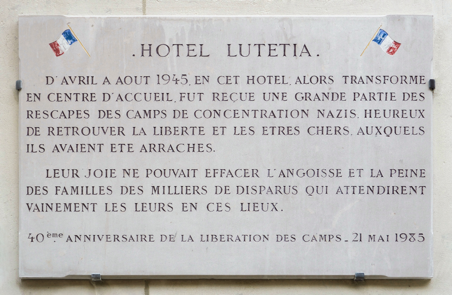
The translation is:
Between April and August 1945 this hotel was transformed into a Welcome Centre and received the bulk of the detainees from the Nazi concentration camps. Happy to find their freedom once again and their loved ones from whom they had been taken.
Their joy cannot erase the agony and pain of the thousands of families whose loved ones did not return. They waited at this spot in vain in the hope they would.
40th Anniversary of the Liberation of the Camps 21 May 1985
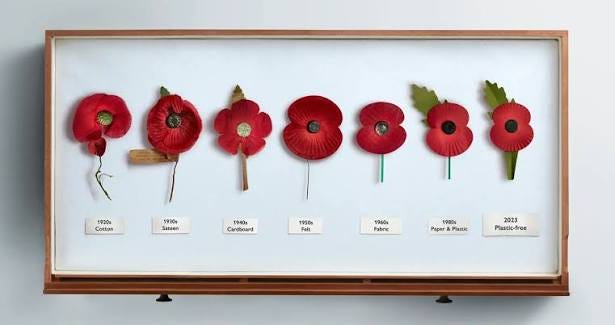
As we approach Remembrance Sunday, let us remember the innocent victims of war as well as the armed forces who valiantly fought and were injured, or made the ultimate sacrifice.