Journal ·
Searching for Shakespeare
And the biography that never was
Elizabeth I had survived nearly two dozen assassination attempts by the end of the 1580s. By then the use of those associated with her theatre had become an essential part of her spy network. Yet, aside from the murder of Marlowe, little has been written about how well the players and playwrights served the queen. Some time ago, I put together a treatment for public television in the United States based on a biography I wanted to write with the working title, Searching for Shakespeare’s Lost Years.
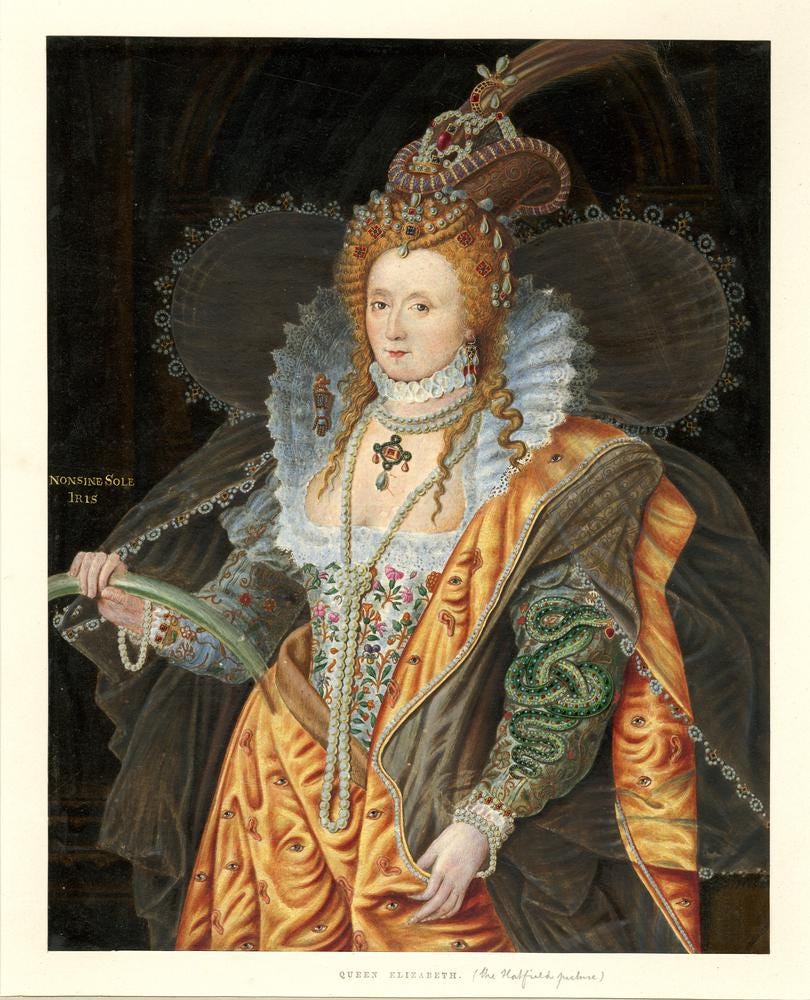
(Above: The Rainbow Portrait at Hatfield House. The symbolism is unmistakable: the rainbow denotes peace, and the eyes and ears mean she sees and hears everything. The pearls once belonged to Mary Queen of Scots when she was Queen of France. Although painted sometime between 1600 and 1603 when Elizabeth was in her late 60s, she is portrayed as a young woman.)
Few realise that Elizabeth acted through several of her favourites. William Cecil Lord Burghley, Sir Francis Walsingham, Robert Dudley Earl of Leicester and many others had been using the players as secret weapons in their individual or collective arsenals of spies. The practice was widespread. Playwrights like George Gascoigne and poets like Edward Dyer were charged by these secret services answerable to the queen to report on activities of certain noblemen in whose homes they had entertained.
You’re probably wondering ‘so what about Shakespeare?’ His ‘lack of history’ between 1583 and 1590, according to Shakespeare scholars has been labelled as his ‘Lost Years’. It is precisely about this period I’d hoped to write a biography. My five-years’ archival research made a convincing argument for William Shakespeare’s departure from Stratford-upon-Avon in 1581 for Oxford to work as a ‘schoolmaster in the country’ before travelling to London in 1583 or 1584. By 1586, he was most likely in the Low Countries (The Netherlands) taking part in the Elizabethan Age of Adventure.
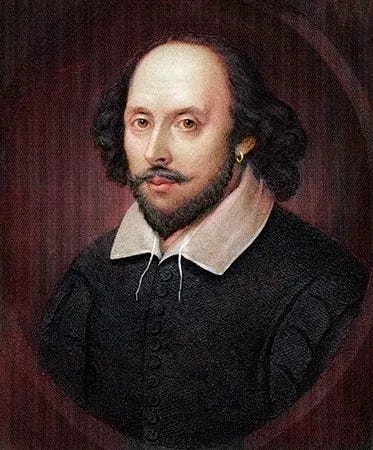
(Shakespeare Portrait at National Portrait Gallery)
Woah! Okay, let’s back up. For the sake of argument let’s assume that Shakespeare was seeking a better life, position and knowledge. To do so, he would have had to attach himself to some young nobleman heading for London and Elizabeth’s court. (I will still keep schtum here about the research into Shakespeare’s mental gymnastics and intellectual prowess. . . which would have been in the book.)
The first stop for any young nobleman in Shakespeare’s day was Oxford University or University of Cambridge. In researching the Oxford matriculation lists, I discovered a wealth of possibilities, including William Lucy, son of the family that accused Shakespeare of ‘deer park poaching’. Yet a recurring name meant more to me: John Saresbury (or Salusbury as he was later called), a ward of Robert Dudley, Earl of Leicester. Saresbury went up to Oxford in November 1581 (like Lucy), taking an ‘usher’ or private tutor from Stratford-upon-Avon with him. Was it Shakespeare? The Stratford-upon-Avon archives and other Warwickshire documents provided interesting reading. . .
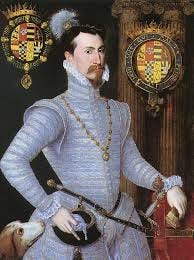
Saresbury would later become the dedicatee of Shakespeare’s long poem The Phoenix and the Turtle. Also present at Oxford were John Donne, Samuel Daniel and the great Italian tutor John Florio. Jonathan Bate has put forward a premise which I also believe: Florio’s first wife, Anna Sorosollo, was a very credible candidate for Shakespeare’s ‘Dark Lady’. John Florio also had a Leicester connection, dedicating his 1578 Italian primer Florio’s First Fruites to Robert Dudley Earl of Leicester.
While some Shakespeare scholars have tied Florio to Shakespeare for the past two centuries due to references in Shakespeare’s plays and his knowledge of Italian, few have thought that Shakespeare may have gone with Florio to London in 1583 as an ‘usher’ assisting with the education of the numerous Florio children. For the next two years, Florio was employed in the French embassy as ‘tutor’ to Katherine Marie, the daughter of the French ambassador, Michel de Castenau, Sieur de Mauvissière. At the same time, Florio was also a spy for Sir Francis Walsingham. Living at the embassy as well in those years was the controversial Italian philosopher Giordano Bruno. We know this because Bruno refers to Florio in his writing as ‘his companion’. If Shakespeare had been part of the Florio entourage, he was mixing in high and secretive intellectual company. In 1585, Florio published a pamphlet in London based on the papacy’s and Catholic France’s intentions towards Elizabeth’s Protestant England: A letter lately written from Rome, by an Italian gentleman to a freende of his in Lyons in Fraunce.
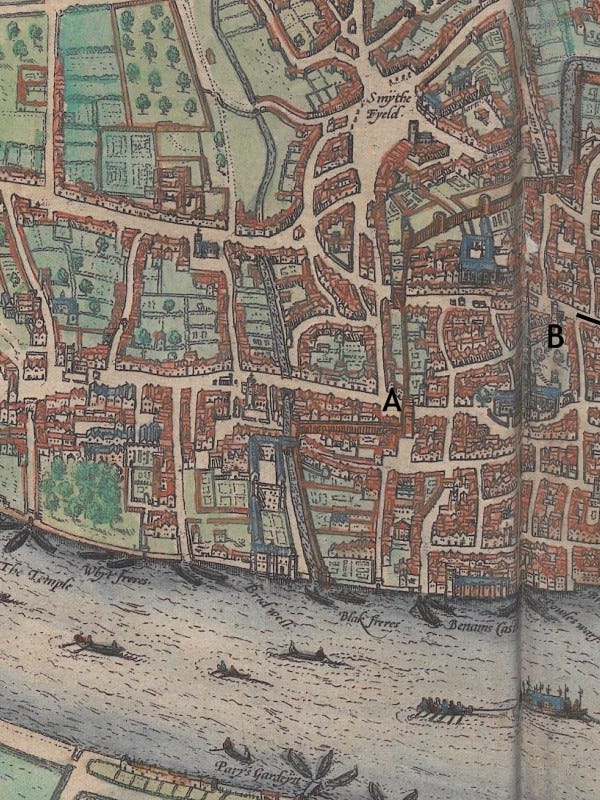
But. . . let’s go back to John Saresbury for a minute. Saresbury left Oxford and became one of Elizabeth’s courtiers in London in 1584. Logically, he required a retinue and Shakespeare may have accompanied him. In the autumn of 1585, the Earl of Leicester mortgaged Saresbury’s lands and manor to pay for troops (which Saresbury joined) to go to the Low Countries as Leicester’s contribution to the war against Spain. Shakespeare’s friend John Heminges, a court grocer at the time, led a group of 150 volunteers to act as victuallers to the army. Shakespeare may have seen action; then melted into Leicester’s Men with Heminges at Utrecht in April 1586. The Dutch archives had more tantalising information. . .
Shakespeare obviously knew Saresbury, a minor courtier, later in life… Naturally I combed through more archives to see if Saresbury (or Salusbury) and Shakespeare may have had associations in their ‘salad days’. And so, on to the Welsh archives…
The original stimulus in searching for the ‘lost years’ came through my archival research in writing The Pirate Queen and Heretic Queen about Elizabeth I’s reign. If the Saresbury connection panned out, Shakespeare may well have been alongside his fellow sharer John Heminges in the autumn of 1586, fighting in the bloody struggle from Spanish domination in the Low Countries. He may have rubbed shoulders with Walsingham’s son-in-law, Philip Sidney too before Sidney’s untimely death there. Further investigation amongst parish archives and the ‘known’ biography of Shakespeare made me want to find out more. Off to the Grocer’s Company. . .
In the winter of 1585, Elizabeth dispatched Thomas Bodley (of Oxford’s Bodleian Library fame) to Frederick II of Denmark with the message ‘that [it is]the purpose of the Guise to force the king [of France] to deprive the King of Navarre of his succession to the crown.’ (Mary Queen of Scots was tied to the Guise family.) Walsingham had reinforced Bodley with two of his best spies, Robert Poley and Nicholas Skerres. Those names may be familiar to some. . . both Poley and Skerres were present at the murder of Christopher Marlowe 30 May 1593. Skerres’s friend Ingram Frizer was accused of the murder but was pardoned by Elizabeth I in strange circumstances.
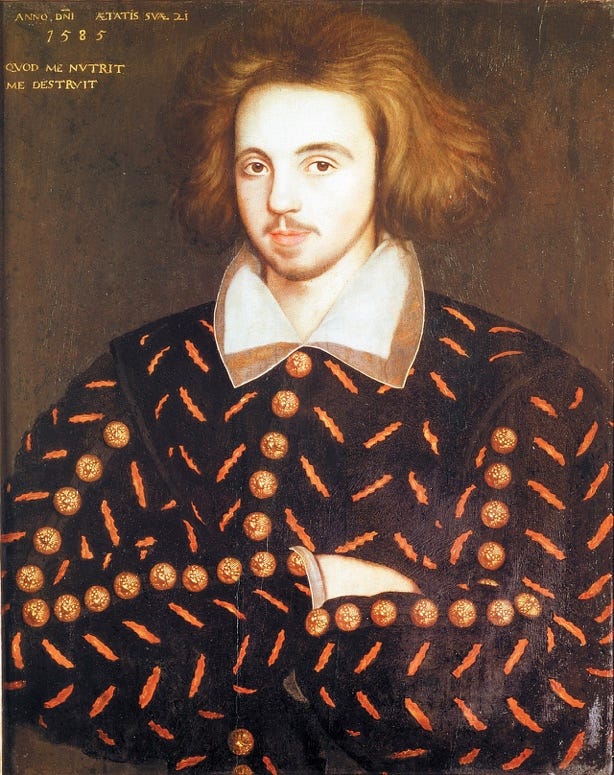
(Christopher Marlowe, 1585. Corpus Christie College, Cambridge)
Six years earlier, Burghley used Marlowe as a spy. Like Leicester and others, Burghley had his own spy network (including one aboard Drake’s Golden Hind) and had used the impoverished and outspoken Cambridge scholar. It was Burghley’s largesse which paid for Marlowe’s ale and privileges from his earliest days at Cambridge. It was Burghley who rescued the outspoken Marlowe in 1587 when he had been accused of defecting to Rheims (meaning that he had become a recusant Catholic). It was Burghley who was in charge of Marlowe’s ‘mock’ interrogation and Burghley who released Marlowe back to his spying duties on behalf of the Crown.
Back to 1585 and Bodley in Denmark. . . The English ‘gentlemen’ Bodley, Poley and Skerres were met there by Leicester’s Men who had come to play at Elsinore in Kronberg Castle for the Danish king. Poley and Skerres reported to Frederick II on the Dutch debacle against their Spanish overlord Philip II of Spain. The Danish archives document the visit of Leicester’s Men at the time, too. Did that give rise to the play-within-the-play in Hamlet I wondered.
If I’m right about Shakespeare joining Leicester’s Men in The Netherlands and returning to England with them at the time of the aborted preparations for the ‘failed’ Spanish Armada attack of 1587 (Drake had stolen all the barrel staves for victuals and water at Cadiz, delaying it by a year), we then see Shakespeare for the first time attached to the London theatre as a ‘fixer’ of ‘stale’ manuscripts – including the play Sir Thomas Moore. Like most other playwrights at the time, Shakespeare had a brush with Edmund Tilney, Master of the Revels over the ‘stale’ play.
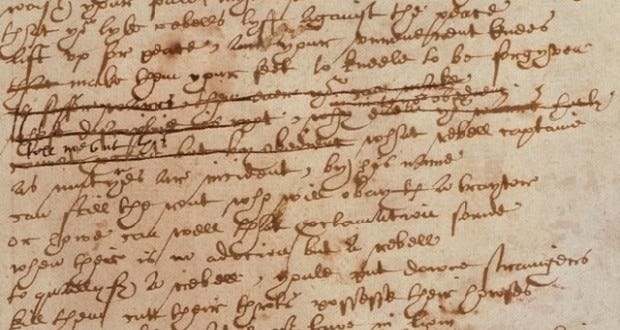
(Hand D writing in secretary hand – different to the script we use today.)
But even then, Shakespeare remains elusive. There were at least three sets of alterations to Sir Thomas More, with the final changes giving us a rare glimpse of William Shakespeare’s secretary handwriting – Hand D. The play was sympathetic to Sir Thomas More as the Lord Chancellor who refused to recognise Henry VIII’s position as the head of England’s church. It was controversial to say the least. The play remains officially anonymous to this day. William Shakespeare discovered early on to avoid Tilney’s displeasure and the sensibilities of the Crown.
My book Searching for Shakespeare’s Lost Years was never written for two reasons. First, my editor reminded me that I am not a Shakespeare scholar. I’m just a biographer and historian of Elizabethan England, screenwriter and novelist. When I spoke to Stanley Welles about it (at Kronberg Castle, Elsinore in 2011), he said no one was interested in what Shakespeare did before he was famous. Besides, ‘the play’s the thing’. Second, I was thrust into the twentieth century when the largest Nazi looted art hoard finally became public in 2013. I was asked to write Hitler’s Art Thief. I had seen the collection in a Swiss bank vault in 1998, but no one believed me for fifteen years.
Maybe no one believes my research into Shakespeare’s life either. . .