Journal ·
Shakespeare Didn’t Play Cricket
And why it matters that Shakespeare understood the rules of the game.
Naturally he didn’t play cricket as we know it. What became ‘cricket’ was a game played mostly in the Weald of Kent and first recorded in writing in 1597 – by which time Shakespeare was a known playwright.
The game would have to wait around another 150 years until some gentlemen and noblemen at ‘The London Club’ of the Artillery Ground in Finsbury set down the laws of gentlemanly play – mostly designed against cheating – in 1744. The laws were revised 30 years later in 1774 and after the founding of the Marylebone Cricket Club (MCC). It issued updated laws in 1788, and it became ‘The Home of Cricket’ around the world. These early beginnings explain why any unfair play at cricket today is lamented and taken very seriously.
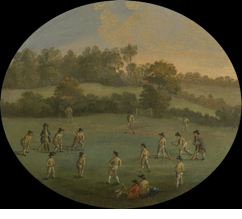
In the Victorian era, the concept of bad behaviour for a ‘gentleman’ was understood in the phrase of something or someone being ‘not cricket’ – meaning unfair or cheating. (Ladies were deemed to behave as ladies at all times back then since sadly they were barred from playing.) Separately to the game played on a cricket pitch, the unwritten rules of cricket in life off the pitch have since stood the test of time for any breach in a code of honour in school, politics, business, war and private life. I hope you see where I’m going…
Respect for captains, teammates, opponents, umpires and their authority is central to cricketing life. Creating a positive atmosphere through one’s conduct and encouragement for others to do the same is part of the ‘spirit of cricket’. Self-control, even when decisions go against the player, congratulating opponents on their successes and thanking those who officiate no matter the result are now imbedded since 2017 as ‘the Spirit of Cricket’ in the MCC’s preamble.
You’re probably wondering why if Shakespeare did not play cricket, I’m tying him to the game…
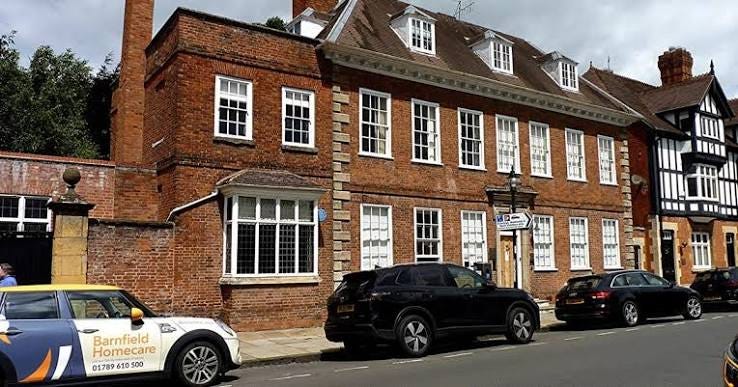
(Shakespeare Institute, Mason Croft, last week. Photo: Jeff Gogarty, CC BY-SA 2.0)

On Friday 13 November, the Shakespeare Institute announced that the University of Birmingham (part of the Russell Group of universities) whose campus is at Edgbaston will close the Shakespeare Institute in Stratford-upon-Avon and move it to its Edgbaston campus from September 2027. While rumours had been flying for some while, the announcement came as a shock.
The Shakespeare Institute’s director Professor Michael Dobson said he would resign rather than ‘aiding and abetting’ the move. In a statement to the Stratford-upon-Avon Herald that unlucky Friday afternoon, Professor Dobson said:
“I am very sorry to have to inform you that yesterday the assembled faculty of the Shakespeare Institute were told by university management that as of September 2027 we are to leave the building the Institute has occupied in the centre of Stratford since 1951, and transfer its operations to unspecified rooms on the main Birmingham University campus in Edgbaston. We are told that the university does not yet know what it will then do with this listed building, Mason Croft, nor with its historic garden and playing fields.
We were not party to this decision, and we were not allowed to inform it. I personally do not expect that the Institute’s long-established MA programmes in Shakespeare studies will long survive the move (students tend to come to the Institute because they wish to be in Shakespeare’s home town and close to the RSC, not because they have strong feelings about Birmingham), and without Shakespeare students to teach I fear my colleagues will soon be at risk of redundancy.
I will myself be resigning rather than aiding and abetting this move, and my deputy Professor Tiffany Stern has accepted a new position at Yale.”
That weekend, I was reliably informed that Birmingham was uncertain where it might put the Shakespeare Institute and its 60,000 work library but insisted that Shakespeare studies would be integral to its English department.
You may or may not have seen or heard about the outrage. I was among those who quickly reacted. Officially.
The University of Birmingham made the statement: ‘The study of Shakespeare at UoB remains a key part of our global excellence strategy and relocating the Shakespeare Institute to Birmingham will more fully embed the Institute’s work in a wider and vibrant campus ecosystem’.
It must have been a good decision from a Birmingham viewpoint to eviscerate the local economy in Stratford-upon-Avon, impoverish the unparalleled symbiotic relationship between the Royal Shakespeare Company and the Shakespeare Birthplace Trust in William Shakespeare’s home town, and not consult with the director of the institute or its employees or say where they and their library would be housed. To my mind it was ‘not cricket’… to say the least.
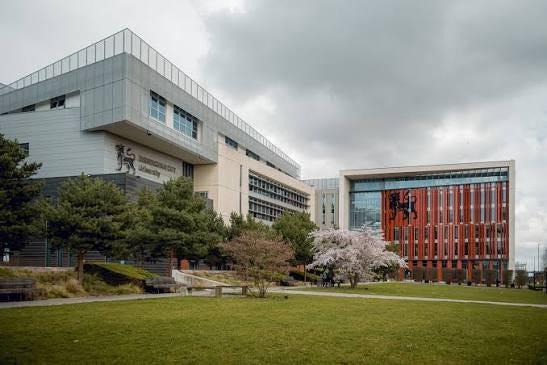
University of Birmingham Faculty of Arts
Anyway, the outcry was tremendous with over 40 initial signatories to the open letter within two days. I was among those signatories as Former Chief Executive of the British Shakespeare Association. That number stands at 73 this morning, including Dame Judi Dench, Sam West, Harriet Walter, Simon Callow, Miles Jupp, Imogen Stubbs and other known Shakespeareans as well as academics, theatrical directors like Sir Gregory Doran and producers. If you don’t believe me, here’s the letter:
https://www.savetheshakespeareinstitute.org.uk/
But that was nothing compared to signatories on the petition where people from all walks of life showed their disgust for the travesty:
https://www.change.org/p/stop-the-closure-of-the-shakespeare-institute-in-stratford?source_location=search
So far there are 19,716 people who have signed. As I write this another 322 people have added their signatures. The ‘studentsofstratford’ have been very vocal too. Stratford-upon-Avon’s citizens and its MP, Manuella Perteghella are joining the fight.
Even University of Exeter wrote an open letter, signed by 47 academics about the folly of Birmingham’s decision. Thanks to Lizzie C. Hughes (and the dumbing down of Google with its Gemini A1) you may read it here:
https://www.facebook.com/lizzie.c.hughes/posts/10163629694711705/
On Tuesday 17 November Professor Adam Tickell, Vice-Chancellor of University of Birmingham stated that:
‘Over the coming months, the university will work with the Royal Shakespeare Company, the Shakespeare Birthplace Trust, institute colleagues, students, alumni and other partners to explore the institute’s future.’ (from The Independent).
This does not mean that the university’s decision will be change. It does mean it will follow best practice in its decision and in law. It does not mean that the rules of cricket have applied or will apply in future, even though one of England’s greatest cricket grounds is located at Edgbaston, too. Although, the English language’s greatest poet and playwright never worked there and called Stratford-upon-Avon home…

England v India photograph by JimmyGuano - Own work, CC BY-SA 3.0.
Ah, I think I hear some naysayers who are thinking I haven’t proven that my subtitle is correct… that Shakespeare understood the ‘rules of the game’ of cricket. There are of course myriad examples of right and wrong and justice and injustice in his works, but let’s just try these on for size:
From Measure for Measure: ‘Condemn the fault, and not the actor of it?’ (Act 2, Scene 2) . I presume that those mentioned from University of Birmingham were ‘actors’ in this fault. Surely they were not part of the fault itself?
From Henry VI, Part 2: ‘Poise the cause in justice’s equal scales/Whose beam stands sure, whose rightful cause prevails.’(Act 2, Scene 1). Again, fairness rules. Has fairness applied here?
I could go on and on. But I’ll close with a quote from Henry VIII (Act 3, Scene 2): ‘Be just and fear not.’
I’m no academic, but maybe the university will decide to relocate its MA and PhD course from Ironbridge Institute next?