The Gurlitt saga began for me in 1998 on one of those heavily laden, bone-chilling winter days that curse Europe from late October to April. Back then, I was an investment banker specializing almost exclusively in the restoration of historic buildings and landscapes and their conversion to alternative use. To my knowledge, I was the only such independent beast in the licensed “banking community,” which made me as rare as a golden unicorn to some (or a proverbial dragon to others) and gave me a very minor “rock star” status. I recognized that I was able to see and know things and places most people could never glimpse. That said, I’d grown curmudgeonly and badly needed a change. I had no inkling that this would become one of the most significant days in my working life.
It was just another day trip to Zurich, like so many dozens of other day trips I had made in previous years. With a Swiss institutional shareholder, Zurich, Geneva, and Lausanne were familiar stomping grounds in the pursuit of bona fide investors. Snow threatened, and I was anxious to meet my prospective investor with his bank manager and swiftly take back proof of his ability to invest millions in the project I was currently working on before the storm broke.
My destination was one of the richest city blocks in the world—Bahnhofstrasse, home to the world’s premier banks and, more important, their moneyed clients from across the globe. Swiss bank-secrecy laws attracted the superrich and ultra-notorious alike—especially back then. Today, things are marginally different.
The meeting with the prospective investor and his personal bank manager went well, and as a final step for the day, it was necessary to go to the bank’s vault to verify the share certificates, certificates of deposit, jewels, and art. I was a thorough kicker of tires.
For those readers who have never seen one, there is something quite incredible about a Swiss bank vault. Each is a Pandora’s box in its own way. In some cases, the vault is akin to a small, hushed city. In others, it is like wading through the treasure-houses of yore. The larger ones do not resemble what we see in films or television. Nor do they look like an Aladdin’s cave, even though they are just as rich in wealth and contain enough untold stories to rival the number of stories Scheherazade told.
This particular vault was of the small-hushed-city ilk. The only sound to be heard was the bank manager’s heels clicking against the stone floor—but even these were muted by the soundproofing. I couldn’t help thinking it was a great place for a murder at closing time—stuff the body between the rows of sliding walls and it would only be detected by the rank smell of decomposition days, if not weeks, later…unless, of course, some hapless art owner wanted to visit his treasured trove where the body had been hidden.
This enormous vault room held row after row of numbered sliding walls with a wide aisle in the center. Each wall was filled with fabulous artworks hidden from prying eyes. As we made our way to the investor’s wall, I noticed that a sliding wall had been left slightly ajar. I saw the fringes of what I believed was a nineteenth-century landscape painting and the letters “RLITT.” Rlitt? Gurlitt? Could that be a painting by Louis Gurlitt, the nineteenth-century landscape painter? I wondered aloud without realizing it. The bank manager swivelled round suddenly and glowered at me, pushing the wall shut. “No. That’s the twentieth-century Nazi art dealer,” he huffed.
I was never a good poker player. I was stunned and hid it poorly. The manager immediately realized his blunder and tried to recover himself by blustering. I shouldn’t have been peeking at private property. It was against Swiss law. I was being brought into the vault at the behest of a valued client (meaning the investor) and represented a highly respected institution. I apologized, but both of us knew that the damage was done. Nonetheless, we continued in a distinctly tense atmosphere to view the assets of the potential investor.
Despite returning to professional dignity, I knew instinctively that there was more to this story. I’d never heard of a twentieth-century Nazi art dealer whose name ended in “RLITT.” Was his name Gurlitt like the painter’s? Or was it something else? Surely it couldn’t be the landscape painter Louis Gurlitt. If my memory was right, he hadn’t lived into the twentieth century, but I couldn’t be sure. My art-history studies had been part of a life I’d never been allowed to live by a demonic father who believed that all artists were “freaks”—or at least that’s what he told me when he burned my art portfolio on my conditional acceptance for a bachelor of fine arts degree. Yet that was the past—another country.
As we left the vault, I thought back to other such visits. A day in a Geneva vault virtually smacked me between the eyes—and how that potential investor gloated about how he had saved all the art and artifacts from Egyptian Jews who feared they would be killed if Rommel’s Afrika Korps overran Egypt. Stupidly, I asked why the art was still there, given that Rommel failed. He simply smiled, sphinx-like, in reply. So, this is what an art looter looked like.…
At lunch, the bank manager overplayed his hand once again, trying to ply me with wine. I declined. I could see from his expression that he thought I was a “recovering alcoholic,” so why disabuse him? I was used to bankers underestimating me. So, he continued on his set course regardless, apologizing for his outburst in the vault, pouring himself drink after drink after drink. He should never have exploded like that at me, he said. After all, it wasn’t my fault that the sliding wall hadn’t been closed properly. Obviously the prospective investor had chewed him out royally. The bank manager’s groveling became so overwhelming that I couldn’t help but feel sorry for him. It’s not often a Swiss bank manager makes such a faux pas.
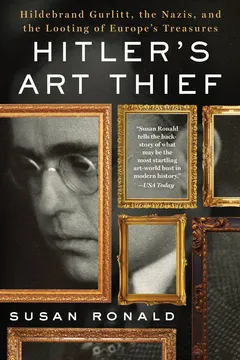
So, I was mischievous and played on his sudden change of heart helped along by his nervous drinking. I popped the searching question, mustering my best innocent voice, and asked if there was a twentieth-century art dealer called Gurlitt. Was there ever! the bank manager exclaimed. He wasn’t just any art dealer—he was Hitler’s art dealer. Hildebrand Gurlitt was his name.
Hildebrand Gurlitt was one small, yet significant, cog in this criminal machinery of state. He brings the scale of the criminality down to a level that most of us can comprehend. As Hitler’s art thief, he stole the lives of his victims, as well as the lives of his wife and children. His crime, like the crimes of thousands of others, went unpunished, as it was judged best that the order givers alone should be tried for crimes against humanity. No one was put on trial for art theft in Germany. Most Nazi-approved museum directors continued as before. Gurlitt’s boundless zeal and secret hoard of ill-gotten artworks—which were kept without remorse—are his true crimes.