Tuesday, October 22, 1940
On the same day Adolf Hitler traveled south to the French border with Spain for talks with Generalissimo Francisco Franco, U.S. Ambassador Joseph Patrick Kennedy bid his farewells to senior members of his team at the American Embassy in London. As staffers shuffled out of the ambassador’s office, some were dabbing tears from their eyes while others sported half-hidden, sly smiles. Despite their differences of opinion about the ambassador, each one recognized that it was the end of a turbulent era of American diplomacy in Europe. In his two years and seven months in England, Joe Kennedy had been taken to the peoples’ hearts, then widely loathed. From the outset, he was feared and deemed insufferable by both the White House and the State Department.
When Kennedy stepped out onto Grosvenor Square for the last time, the ever-present, international newshounds barked: What will you do now, Mr. Ambassador? Uncharacteristically, Kennedy merely smiled. Standing ramrod tall in his homburg and overcoat, perhaps some pounds thinner than his normal svelte self, the press generally remarked that old Joe wore a somber, even sullen face. Some mistook it as regret at being recalled “for consultation” by President Franklin D. Roosevelt. But this was no recall. And there were scores of people who knew it. Joe Kennedy was going home to put FDR out of a job.
Predictably, photographers begged the ambassador to turn this way and that. Jim Seymour, one of Kennedy’s stalwart Hollywood friends, was asked to shake his boss’s hand one last time for the cameras. Flanked on his right by his most private Mister Fix-It, “London Jack” Kennedy, the ambassador obeyed, seething. Minutes earlier, Kennedy’s press handler, Harvey Klemmer, gave him a final warning: “For Heaven’s sake do not say anything before you see Roosevelt at the White House, for if you do, it will mean, politically, gravely damaging things.” So, Joe hung onto his quick Irish temper and thought of his sons’ futures.
Then, the throng unexpectedly parted, making way for the giant figure of Prince Monolulu—the feted horseracing tipster wearing his ostrich feathered crown, black and gold waistcoat, multicolor silk trousers and matching frockcoat. Monolulu bellowed in a deep, honey-coated voice his famous strapline, “I have a horse….” The photographers snapped away while Monolulu whispered to Kennedy the name of his favorite thoroughbred running that day. Of course, the ambassador had made use of Monolulu’s tips during his leisure time at the races with England’s ruling elite. So, Joe gave Monolulu a smile, not quite hiding his irritability. When Kennedy turned away from the embassy, he also left behind the pinnacle of his public service career.
But Joe Kennedy was both bitter and aggrieved. Everything had changed since his arrival in Great Britain on March 1, 1938. Former Prime Minister Neville Chamberlain, Kennedy’s great friend, was dying. Winston Churchill, who Kennedy never trusted, had become prime minister instead on May 10, 1940. Joe had made acres of friends in high places. Then, he lost the esteem of all but a select few. The ambassador had a long memory, particularly when it came to grudges, and would never forgive Churchill, who in Joe’s opinion, had laid his military blunder in Norway that April at Chamberlain’s feet. Just the same, as Kennedy was driven south to Bournemouth in thickening fog to catch his clipper flight home, he never thought that the brickbats hurled at him by the British predated Churchill’s rise by over a year. Undoubtedly, the shots that stung the most came from the big guns of the White House and the U.S. State Department.
By October 1940, Kennedy’s outrage was aimed at the two-term Democrat, President Franklin D. Roosevelt, for how shabbily he had treated his ambassador to the Court of St. James’s. Joe was determined to wreak his revenge on the president’s bid for a third term in just ten days’ time by urging everyone to vote for the Republican candidate, Wendell Willkie. Months earlier, Joe had told Clare Boothe Luce—his lover and wife of publisher Henry R. Luce of Time, Fortune, and Life—what he planned to do. While Clare soothed his ruffled brow, Joe might have forgotten that she was a die-hard Republican and could have had an ulterior motive in fueling his flames of indignation against the president.
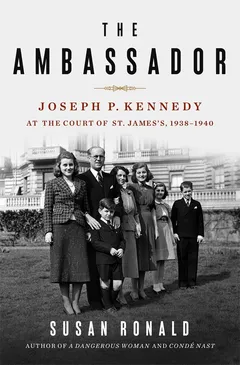
And yet, Kennedy’s wife, Rose, had written to her husband a few weeks earlier that she wanted to tell Roosevelt she would “guarantee to chloroform you [Joe] until after the election.” This is the true story of Joe Kennedy’s rise to the pinnacle of his public service career as U.S. Ambassador to the Court of St. James’s in London and his fall from grace.