Golconda
The Sancy Diamond’s story, and indeed the history of power and greed behind all large diamonds, begins at the famous Golconda mines in India. These stories are steeped in the mystical folklore and superstition that are the bedrock of the spiritual, economic, political and social history of gems. The first rumors of Golconda and its huge diamonds trickled westward to Europe through tales of the awestruck Venetian traveler Marco Polo following his visit to several Indian kingdoms in 1292. He wrote in his Most Noble and Famous Travels at the time:
I will pass hence unto the countries of India where I Marco Polo dwelt a long time; and although the things which I will declare, seem not to be believed of them that shall hear it, but have it in a certainty and of a truth, for that I saw it all with my own eyes. . . In the mountains of this country there be found Adamants [diamonds]. And after they have had much rain, the men go to seek them in the streams that run from the mountains. . . Also there be strong serpents and great, very venomous, seeming that they were set there to keep the Adamants that they might not be taken away, and in no part of the world there is found fine Adamants but there. . .
At the time when Alexander the Great (356-323 BCE) made his conquest of Asia, the Greeks wrote about a legend of the Valley of the Diamonds that held a fortune of diamonds in plain sight – a fabulous treasure that was guarded by serpents. The story was told and retold over the centuries and formed the basis for the legendary tales of Sinbad the Sailor in the Arabian Nights, written by an anonymous author, now described as a pseudo-Aristotle, who explained:
Other than my pupil Alexander, no one has ever reached the valey where the diamonds are found. It lies in the East, along the great border of Khurasan, and it is so deep that a human eye cannot see to the bottom. When Alexander reached the valley, a multitude of serpents prevented him going farther, for their glanced proved mortal to men. So he resorted to the use of mirrors: the serpents were caught by the reflection of their own eyes and so perished. Alexander then adopted another ruse. Sheep were slaughtered, then flayed and their flesh cast into the depths. Birds of prey from neighboring mountains swooped down and carried off in their claws the flesh, to which countless diamonds adhered. Alexander’s warriors hunted the birds, which dropped their booty, and the men merely had to gather it where it fell. . ..
The word diamond, from the Greek adamas, means invincible. Gem-quality diamonds were the most highly prized of all precious stones, from the moment they were first discovered, for their rareness, pure color, brilliance, transparency and apparent indestructibility.
Diamonds were believed to be gems fit for the gods, and only the most privileged and exalted earthly representatives could possess them. This message was transmitted through the lapidaries – or gem texts written by royal merchants and philosophers since recorded time – in Sanskrit, Persian, Chinese, Greek, Latin, and Arabic, in which the diamond was given the most prestigious position among gemstones. . ..
A good jewel is a source of wealth for kings, and a bad one is a source of evil. Flawed diamonds according to the Brhatsamhita, a lapidary text by Varahamihira, attract the risks of loss of family, fortune, and life. . ..
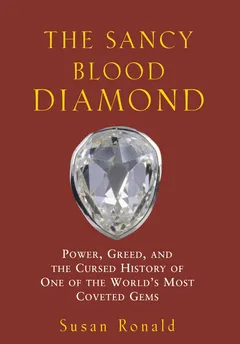
The Sancy is a pure white and transparent diamond. Its weight, estimated by gem valuers in the fifteenth century to be 106 carats, and color would have destined it to ownership by the Indian king. It was found in the oldest area of diamond extraction near Golconda, but the date of its cutting is unknown. Somehow it reached Europe in the late fourteenth century, making it the largest white diamond in Christendom for well over two hundred years.
According to the legendary diamond cutter Gabi Tolkowsky, the cut is definitely Indian, a forerunner of the briolette cut. He can tell this simply from the fact that like many old Indian cut stones, the Sancy’s size was more important than its brilliance: there are fewer facets in the old Indian style, rather than more facets, as in the newer European cuts. Further, one side is more flat, and the other side convex. In the fifteenth century, the cutter would have cut his hands off if it had been done in any other way. Tolkowsky says the Sancy was ‘cut long ago, and most likely in India, and most probably by a Venetian cutter and merchant who would have known its value in Europe.’ …
Precisely when or how the Sancy diamond reached the phenomenally rich and powerful John Galeazzo di Visconti, duke of Milan, is shrouded in the fog of history. But when John succeeded in expanding his sphere of influence to France through the marriage of his stunningly beautiful and perspicacious daughter Valentine Visconti to the rake and rogue Louis, duke of Orléans, brother of Charles VI, king of France, he gave her a dowry beyond belief. . .
including the Sancy diamond. Follow its journey through four royal crown jewel collections. . .