
On Christmas Eve it seems only fitting to write a message about a miracle. Mine involves church bells, which have a very long tradition of calling worshippers to prayer as well as acting as a catalyst for action in times of danger. They bring communities together for local events in both joy and sorrow, and more often than not also include secular activities in a world of declining faith.
What you may not be aware of is that the tradition of bellringing comes down to us from China, where the first bronze church bells were made. Originally used as handbells by Buddhists and Hindus, eventually Christianity adopted them and were first introduced into the church in 200 AD by Paulinus of Nola in Italy. It was another two hundred years before Pope Sabinian in 604 AD agreed they should be placed in every church. By the time church bells made it across the North Sea to Britain another eight-hundred years later, its origins were long forgotten.
In England in the sixteenth and seventeenth centuries, church bells were imbued with mystical powers, just as the Church was the repository of everything supernatural thereby keeping a largely illiterate population in awe. Independent of the liturgy, church bells were deemed to protect parishioners against illness, thunder, lightning and even fire. ‘St Agatha’s letters’ were inscribed on the bells to protect against destruction and the wrath of the Lord. I wrote a little about this in my book Heretic Queen: Queen Elizabeth I and the Wars of Religion.
But in England most prized of all were the bells’ protection against evil spirits. As the Reformation took hold in Elizabeth I’s reign, it was the country superstitions around evil spirits and bellringing that the English people clung to. During the Stuarts, the art of bellringing reached its pinnacle since bells could be ‘tuned’ for harmony and bellringers who could turn bells three-hundred-sixty degrees were sought after for their seemingly otherworldly gifts. Love of one’s church also meant love of its bells, and they remained at the heart Christian worship throughout Europe, an everlasting signpost to all of faith and community. That is until the Second World War.
Between 1939 and 1945, 175,000 church bells across Europe were taken by the Nazis and transported to collection points called Glockenfriedhöfe or bell cemeteries. The largest of these bell cemeteries was located in Hamburg. From there, approximately 150,000 were sent to foundries to be melted down to make shell casings and other armaments including ammunition for the Third Reich. By the end of the war, only 12,000 survived at Hamburg and the Allies instructed the occupied territories to reclaim their church bells as part of the process of restitution of their looted cultural heritage.
Some may think (wrongly) that I’m claiming that if the church bells had mystical powers they wouldn’t have been looted in the first place. Some may even scoff wondering where’s the miracle promised at the outset of this blog?
Let’s try this one on for size:
Like most countries, thousands of the Netherlands’ most beloved church bells disappeared during the war, some of which held not only tremendous emotional value to the Dutch people but also had been inscribed with a white letter ‘M’. This letter gave the church bells an historic and cultural value that was treasured nationally. The letter ‘M’ stood for ‘monumental’.
By the end of 1944, most of the German officers knew the war was lost. Yet, in December the Wehrmacht stole all of the ‘M’ church bells and planned to ship these to Germany to melt down into armaments. The vessel selected to transport them was the clipper ship Hoop op Zegen owned by J. van Dijk from Dordrecht – until the clipper was appropriated by the Germans. The skipper of the Hoop op Zegen bravely refused to cooperate and went ashore in a huff. (If it’s not a miracle that he wasn’t shot and killed I don’t know what is.) The Germans had trouble finding a replacement and finally drafted in an inexperienced skipper to sail to Hamburg.
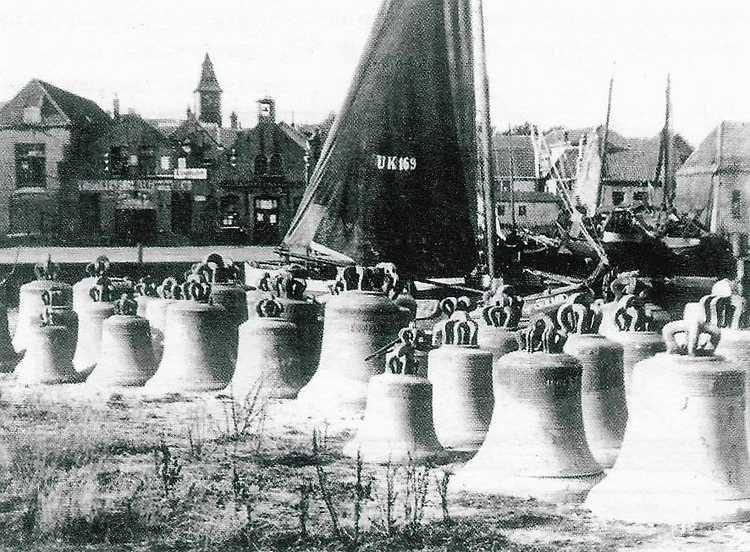
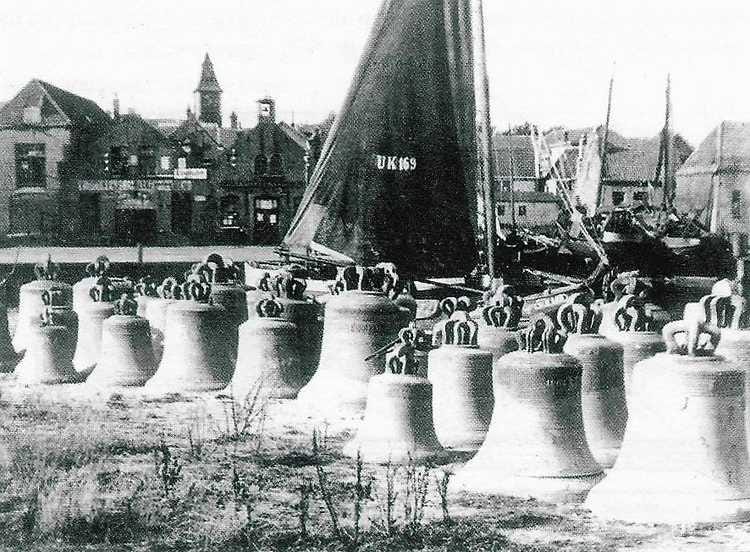
All this occurred in the coldest January of 1945, during the Dutch ‘Hunger Winter’ when thousands were starving to death. The Hoop op Zegen eventually led a small flotilla of ten ships with the cargo of 226 monumental, looted church bells across the IJsselmeer Lake to get to the Frisian town of Lemmer and from there sail on to Hamburg, Germany.
But the Dutch weren’t going to give in without a fight. Without warning, the entire convoy ran aground near the town of Urk. Eight of the ships were recovered the next day. But three of them, including the Hoop op Zegen carrying the church bells wouldn’t budge. It seems news of the fate of the 226 church bells had angered the Dutch resistance and the IJsselmeer’s lighthouse keeper, Jacob Schraal, decided that he had to protect the church bells at all costs. So, he extinguished his lights that night. The Germans were lucky only three ships remained aground.
Still, the Germans were determined. The Third Reich needed the metal from the monumental bells. Sadly, for them, they also needed competent Dutchmen to help. And the Dutch feeling of ill-will spread. There was no way their monumental bells would be melted down. A company called Hoekman en Zonen from the town of Urk was hired as the lead operator to recover the ships and the bells. The Hoekman brothers cannily removed the locking pins from the cargo doors and with other man muscle, threw the bells overboard deep into Dutch waters.
Six months later, the war was over and all the bells and 145 of their clappers were recovered, having never left Dutch soil. All the Dutchmen involved were moved by either faith and/or patriotism to draw their line in the sand. Not one person involved in this act of resistance to save their church bells was summarily executed. If that’s not a miracle, I’m Santa Claus. Happy Christmas.