
Of Legends and Love Stories
Worldbuilding based on history
There’s a wonderful French expression Plus ça change, plus c’est la même chose, translated as ‘the more it changes, the more it stays the same’. The tradition of storytelling goes back as far as humans began to communicate. Legends abound in books, television and film. I’ve often wondered why so many ‘costume dramas’ evoking legends of the past remain so popular.
The traditional books of ‘legend’ that come to mind are of course Tolkien’s The Lord of the Rings and The Silmarillion which together create the legend, or entire mythology, of Middle-earth. In children’s literature it’s CS Lewis’s The Chronicles of Narnia which builds a complete legendary myth and world. Philip Pullman’s His Dark Materials reimagines theological mythology – getting these books banned by the American Library Association for their ‘political viewpoint, religious viewpoint and violence.’ (Personally, I think it’s an odd banning considering the violent society that has yet to stop shootings at schools.)
Frank Herbert’s Dune crafts its intricate mythology around the Fremen and their prophecies where Robert Jordan’s The Wheel of Time has created a complex world with its own Age Lace mythology. Another example among the many I could choose is Patrick Rothfuss’s The Kingkiller Chronicle which weaves stories within stories, creating layers of legend. Prophesies – something the ancient world feared and revered – are alive and well in film and television, too, withStar Wars and the Skywalker saga, The Matrix trilogy with it’s the One and machine prophesies and of course the Game of Thrones and House of Dragon with its Long Night and Targaryen legends.
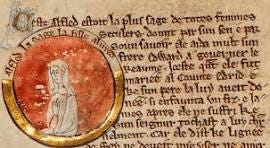
Many worldbuilders and legend creators have a rich tapestry of chronicles and medieval history to draw from like Geoffrey of Monmouth’s Historia Regum Britanniae a pseudo-historical legendary narrative mixing genuine history with pure invention (King Arthur, Merlin, Brutus of Troy). There’s also the Anglo-Saxon Chronicle where different regional variations of the same story appeal to the local populations. Tolkien, a philologist, drew on Scandinavian mythologies like Snorri Sturluson’s Prose Edda and Heimskringla.
There are many other notable examples in books, film and television naturally, but the question I’d like to answer here is what is the attraction to legends?
The most successful legend, myth and worldbuilders create a deep sense of time, of ‘back then’ seemingly happening ‘now’. Tolkien pioneered the technique in his Ages of Middle-earth. His temporal layering makes this unknown, alien and ancient world feel alive, vibrant and recognisable. We feel its resonance in today’s world. At the heart of many of these myths lie uniquely human values, overcoming adversity, heroism, and entwined somewhere within, a legendary love story. And I believe it’s the love story that drives the ‘now’ element within the tale.
Put simply the formula to create a legend and a love story is:
Transcendent passion meets insurmountable obstacle with tragic consequences that reshape their wider world.
The personal heroism or tragedy of the protagonists becomes legendary when it results in an historical change. For example, in Tolkien we have Beren and Lúthien who directly mirror the Greek legend of Orpheus and Eurydice (mortal man pursuing immortal beloved into death’s realm), while Aragorn and Arwen recreate the mortal/immortal tragic choice.
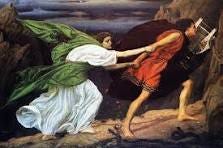
Shakespeare drew on Holinshed’s Chronicles and old histories and legends for his love stories. The love story and legend of Orpheus and Eurydice is obvious in A Winter’s Tale in the statue scene where Hermoine is resurrected, mirroring Orpheus’s overwhelming desire to reclaim his wife. Twelfth Night has echoes of the same love story from its first line ‘if music be the food of love, play on’. It is also evident where Olivia veils her face and rejects marriage to mourn her brother for seven years. Pericles has restoration of a lost loved one at its heart. The Two Gentlemen of Verona has a song ‘Orpheus with his lute made trees’. This is an explicit reference to Orpheus’s power to control nature. The storyline in Much Ado About Nothing involving Hero’s death and her veiled return is again based on Orphic legend.
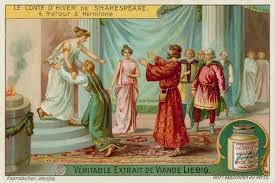
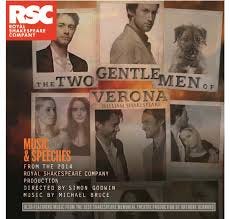
Further references to Orpheus and Eurydice are present through the power of music in The Merchant of Venice, Two Nobel Kinsmen and King Henry VIII. The long narrative poem Venus and Adonis is heavily layered with the Orphic legend as is Romeo and Juliet (although that play’s primary source is the star-crossed lovers kept apart by feuding families in the legend of Pyramus and Thisbe.)
Frankly what’s not to love? A tragic doomed love triangle, as in Tristan and Iseult. A forbidden passion intensified by right and wrong, loyalty versus desire. The Arthurian legend of Lancelot and Guinevere where their love undermines their duty and devotion to the greater good. You, the reader or viewer, can identify, sympathise and actually ‘root’ for a happy ending, or failing that, a satisfactory one. I’d like to believe that most of us root for ‘happy’ – but not in the Hollywood sense.
For me, the most tragic of legendary love stories is the true story of Abelard and Héloïse.
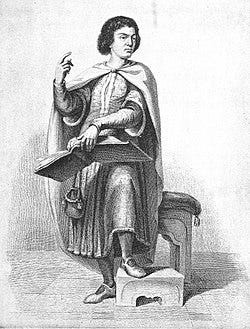
The twelfth-century French scholar, philosopher, theologian, teacher, poet and musician Peter Abelard (1079–1142) was born near Nantes in Brittany, the eldest son of a minor noble family. By 1115, Abelard was recognised as one of the most gifted Catholic theologians and became the master of the cathedral school of Notre Dame in Paris and canon of Sens. Abelard’s fame as a teacher had spread throughout Europe, too. He said he led a straight and narrow life that was only enlivened by philosophical debate.
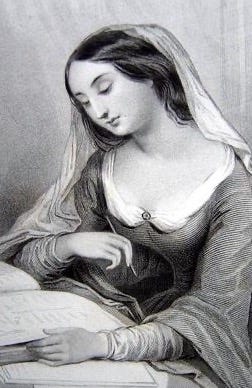
Enter Héloïse d’Argenteuil (1100-1163/64) who lived in the precinct of Notre Dame in the care of her uncle Canon Fulbert. Incredibly, Héloïse was also a scholar who had become famed for her knowledge of classical letters written in Greek, Latin and Hebrew. Abelard had come to believe in his own invincibility as the only undefeated philosopher in debates by the time he met her. He more than likely felt the ‘coup de foudre’ – that lightning strike of love at first sight.
Unable to resist Héloïse, Abelard sought rooms at her uncle Fulbert’s house and began a love affair with her, probably when she was only aged fifteen or sixteen. He felt she was his intellectual equal as well as a great beauty. He later wrote that their love relationship was one of seduction, where Héloïse contradicted him in her letters saying it was a match of equals kindled by their shared physical attraction. What a woman to put that twenty-first century thought into print back in the twelfth century!
Of course, Uncle Fulbert discovered the affair, and tried to separate them, but they continued to meet in secret. The inevitable happened: Héloïse became pregnant. Looking to protect her and their unborn child, Abelard sent her to his family in Brittany, where she gave birth to their son whom she named Astrolabe after the Persian scientific instrument used at the time to tell the position of celestial bodies and popularised by Abelard.
To appease Fulbert, Abelard and Héloïse were married in secret – according to Abelard so his elevation within the church and its practice of celibacy would not come into question. (Again, Héloïse disagreed in her letters.) Even that wasn’t enough to fulfil Fulbert’s wrath. Fulbert revealed the marriage, the child, and Héloïse was packed off to the convent in Argenteuil to protect her from her uncle. There she led the life of a nun. As if that wasn’t punishment enough, Fulbert and his friendly thugs broke into Abelard’s room while he slept and castrated him.
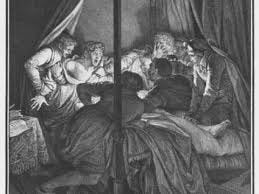
Shamed by his injuries, Abelard retired from Notre Dame and hid himself away as a monk at St Denis. Years later, a letter from Abelard, Historia Calamitatum (History of My Calamities), prompted a famous, raw, and philosophical exchange of letters between the lovers, debating love, duty, and their forced separation. They never met again but their surviving letters are a testament to their tragic love affair and Héloïse’s determination to be a person – if only a ‘weak and feeble woman’ – in her own right.
Theirs is just one true historical romance that became legendary and spurred on many other love stories in literature. Please think about your own favourite legendary love stories leading up to Valentine’s Day. . . be it Emily Brontë’s Heathcliff and Catherine of Wuthering Heights or Connell and Marianne in Sally Rooney’s Normal People, I’d love to hear what they are!